En route to the Phoenix area, I visited the Casa Grande National Monument, which is a small site containing a multi-story Hohokam structure. It is not actually in the city of Casa Grande, where I spent a night.
I also spent a night at the Lost Dutchman State Park in the hills east of Phoenix (pictured at left).
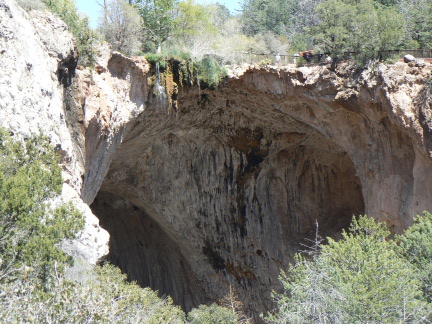
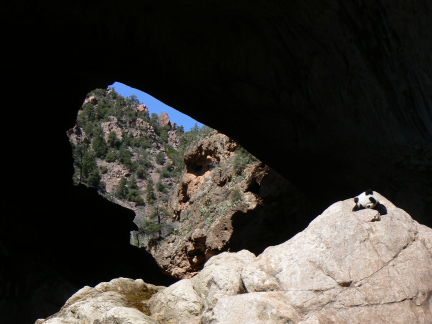
Rather than fly up I-17 from Phoenix to Flagstaff, I decided to take a more scenic route through the forested hills northeast of Phoenix. These roads brought me to the Tonto Natural Bridge State Park, home to "the largest travertine bridge in the world". It's wide and long enough to support a picnic area. There are no really great viewing platforms, despite the park's best efforts. The length and width of the bridge actually make it kind of hard to capture well.
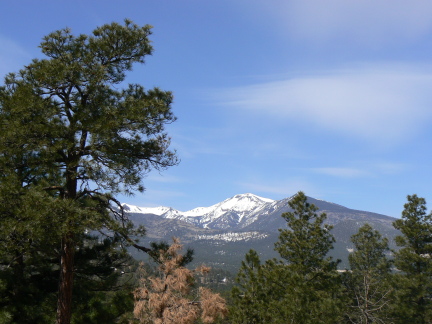
Flagstaff! (Well, the San Francisco peaks, including Mount Humphreys, which was a bit snowy to summit...)
Saturday, April 26, 2008
Friday, April 25, 2008
A visit into the Sonoran Desert
After my fascinating visit to the Chiricahua National Monument, I passed through Tucson on my way toward Phoenix and points north. Outside Tucson is the Desert Museum. This is basically a combination arboretum and zoo, showcasing the flora and fauna of the Sonoran Desert, which is the principal desert area of Arizona. (Parts of Arizona are also in the Mojave Desert, but that'll be a different trip, I think.)
While there, I photographed a number of plants. (I didn't photo the lazy-looking cougar -- it just didn't seem right to do so.) Most of these pictures come either from the museum grounds, or from my travels immediately before and after visiting it.
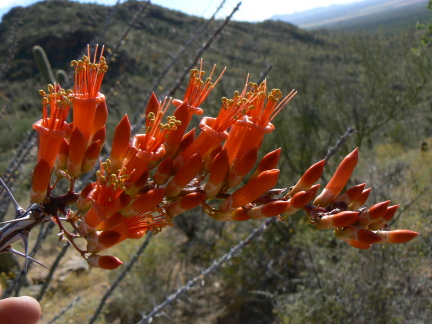
These are the ocotillo.
These are prickly pear cactus in bloom.
There were a large number of yellow-flowered plants blooming in the Tucson and Phoenix areas . These were also widely in evidence down in the Grand Canyon.
While there, I photographed a number of plants. (I didn't photo the lazy-looking cougar -- it just didn't seem right to do so.) Most of these pictures come either from the museum grounds, or from my travels immediately before and after visiting it.
These are the ocotillo.
These are prickly pear cactus in bloom.
There were a large number of yellow-flowered plants blooming in the Tucson and Phoenix areas . These were also widely in evidence down in the Grand Canyon.
Chiricahua National Monument: Other stuff
In addition to rocks, Chiricahua has a few other things, including a natural bridge. (I've highlighted the bridge in the photo -- it's in the upper right.)


Chiricahua National Monument: Individuals
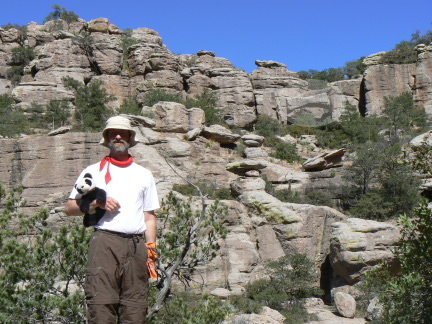
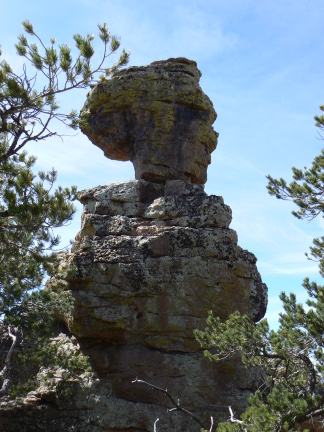
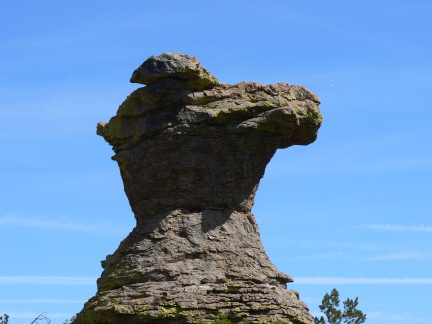
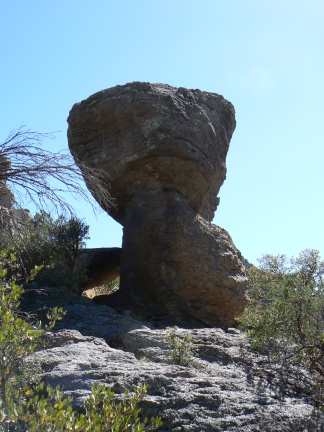
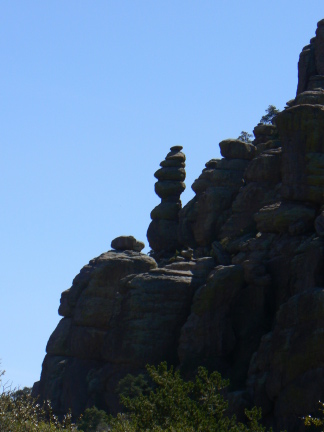
The monument has a large number of interesting rocks. Here's a set of odd-looking rocks.
Some look like moai:


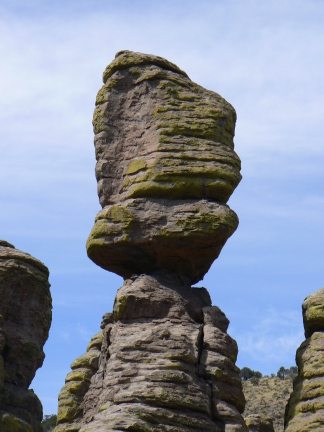
There are quite a few "balanced rocks", including one real doozy:


Sometimes one falls over, and all (or a piece) rests against a neighbor:


Some look like moai:
There are quite a few "balanced rocks", including one real doozy:
Sometimes one falls over, and all (or a piece) rests against a neighbor:
Chiricahua National Monument: Views
After Kartchner Caverns, I went to the Chiricahua National Monument.
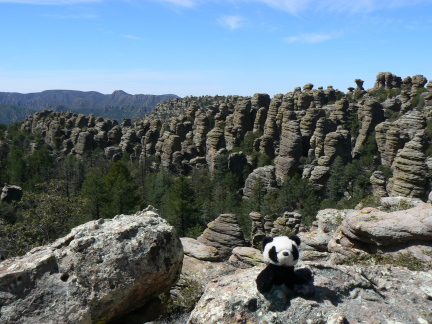
I know, you've never heard of the place, but I managed to take a ton of pictures there. It's a modest place, one small campground, no notable services nearby, 30 miles off the highway. But it has some fantastic wind-and-rain-sculpted volcanic formations. Herewith, a sampling of the views and vistas there...
By the way, that last one is best viewed sideways.
I know, you've never heard of the place, but I managed to take a ton of pictures there. It's a modest place, one small campground, no notable services nearby, 30 miles off the highway. But it has some fantastic wind-and-rain-sculpted volcanic formations. Herewith, a sampling of the views and vistas there...
By the way, that last one is best viewed sideways.
Subscribe to:
Posts (Atom)