Saturday, May 24, 2008

Lake Powell, Rainbow Bridge, and the Navajo Monument


After having spent many days in the remote reaches of southern Utah, I landed in the outpost of civilization called Page, Arizona. Page came into existence as the home for workers constructing the Glen Canyon Dam, and is largely a tourist hub now. I went there so that I could go on a boat ride to the Rainbow Bridge National Monument.

The Rainbow Bridge is a spectacular sandstone arch that is culturally important to the Navajo. (It is said that Navajos will not walk under the bridge.) One of the compromises in the construction of the Glen Canyon Dam was that this bridge would not be drowned (although other places important to the Navajo, such as the confluence of the Colorado and San Juan Rivers, were drowned.

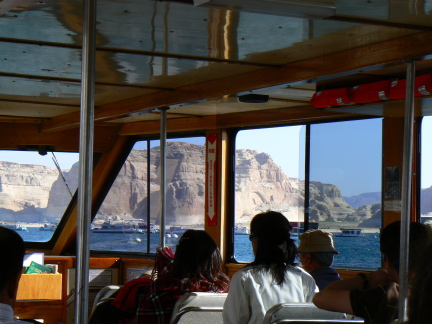
While it is possible to hike to the Rainbow Bridge, most people take a boat to see the bridge. Due to the fairly low lake levels, this is currently an all-day (7 hour) outing. (At higher water levels it can be done in 4-5 hours.) The captain on my tour was an old hand with many stories, and the usual geology lessons that occur on guided tours and ranger presentations in this part of the country. After visiting the bridge, he took the boat (capacity 150 or so) up an extremely narrow side canyon, in which the boat scraped the sides of the canyon...

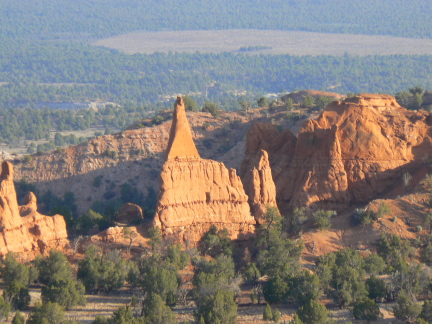
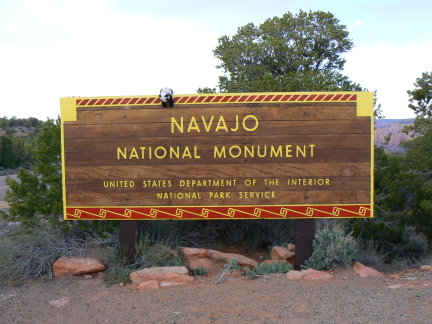
Upon return, I immediately drove off to the Navajo Reservation, which is home (among many other things) to the Navajo National Monument. While it is in the Navajo Nation, the purpose of this monument is to preserve to important AnasaziAncestral Puebloan ruins, Betatakin and Keet Seel.

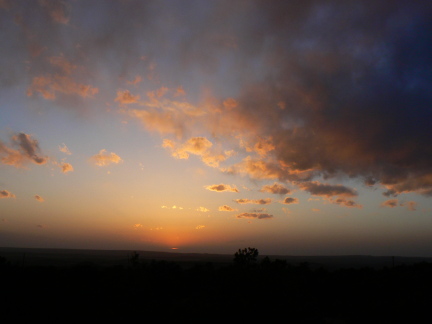
Unfortunately, the monument's services, including access to Keet Seel, don't really start until around Memorial Day, so I was limited to camping (in the free campground), and enjoying the sunset.

Friday, May 23, 2008

The Grand Staircase

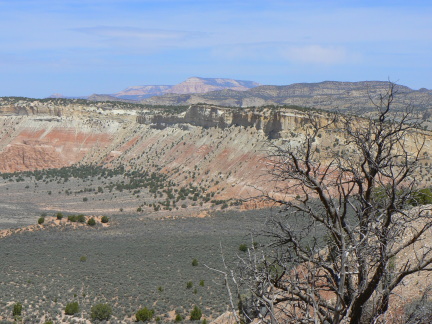
A few miles down the Cottonwood Road from Kodachrome State Park, you get a colorful view of parts of the Grand Staircase.


While the Grand Staircase-Escalante National Monument's purpose is to preserve wilderness and provide access, said access does not have to be easy. In fact, the Monument has remarkably little pavement, and relatively few roads of any sort. However, there is actually a paved, ADA-compliant sidewalk at the Grosvenor Arch in the monument.


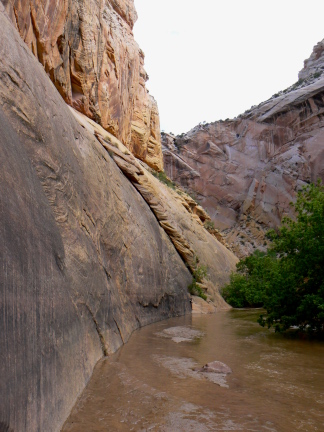
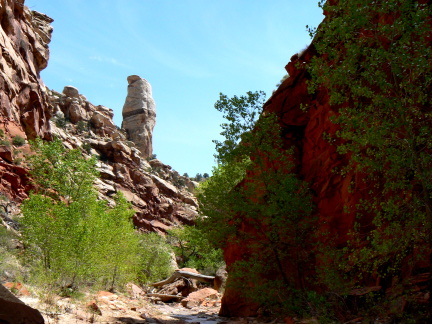
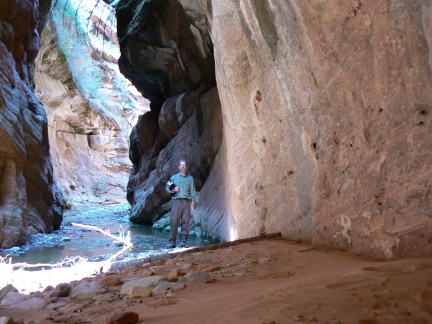
I spent most of a day exploring the lower stretches of Hackberry Canyon. This canyon contains a tributary of the Paria River, and features walls hundreds of feet high near the lower end. I hiked in about 5 miles, to the location of an old mining prospector's cabin. The stream meanders from side to side in the canyon, but was quite shallow, so hiking in the stream was not a difficult proposition, and the greenery in the canyon was quite pretty. (As I sit at home composing this, I have been reading Edward Abbey's Desert Solitaire, in which he lyrically describes rafting down Glen Canyon before it was dammed. It was so named by John Wesley Powell because the lush greenery of the side canyons reminded him of, well, wooded glens.)

Thursday, May 22, 2008

Kodachrome State Park

When you head east from Bryce Canyon NP, along Utah SR 12, you descend the Grand Staircase to the small town of Tropic, where I stayed while visiting Bryce. A short way further down SR 12 is Cannonville, which is one of the jumping-off points for the Grand Staircase-Escalante National Monument. This monument basically consists of two sections, the Grand Staircase and Paria River drainage in the west, and the Escalante River drainage in the east, separated by the Kaiparowits Plateau.

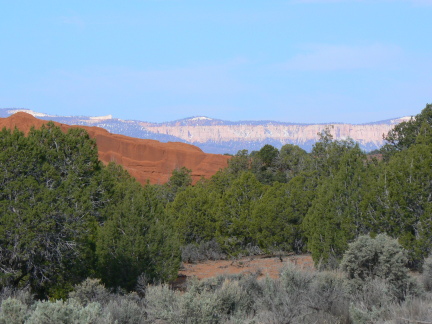
Cannonville is the northern end of the Cottonwood Road, which runs through the staircase region between the Paria River and the Kaiparowits Plateau. Not far from the village is the Kodachrome Basin State Park. The campground in this park is located in an area that is basically a bowl with walls of red slickrock sandstone. While I didn't find the immediate park vicinity to be quite worthy of its name, I did manage to find a few pictures there, including a nice shot looking up the staircase toward Bryce Canyon.

Bryce Canyon National Park

Days 67 and 68 of my trip were spent at Bryce Canyon National Park. It was late April, and Bryce, which is at elevations over 8000', was on the chilly side. Some trails were still snow-bound and not recommended for hiking. That said, many of the best trails were open. I first went on the Navajo-Peekaboo-Queen's loop, roughly 6.5 miles of hiking amongst the hoodoos. The next day I went to Fairyland. This post has a subset of the 100+ pictures I took along the way.

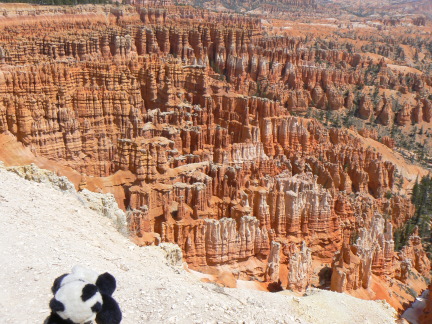
Bear visits the Bryce Canyon NP sign

Bryce is not actually a canyon -- its formations are along one of the cliffs that form part of the Grand Staircase. Here we get some view of the cliff-line.

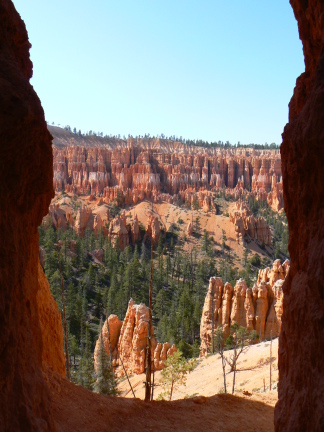
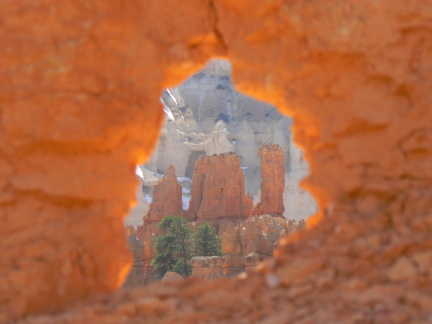
This is known as the Silent Army. It's basically an amphitheater full of hoodoos. The first pic is taken from the rim, the second is a view from the Peekaboo Trail where it quite suddenly comes through a tunnel onto the amphitheater -- it's a quite impressive view.

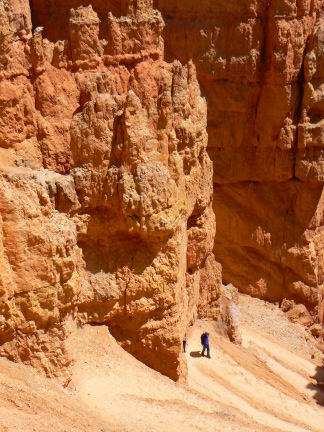
The Navajo Trail descends steeply into the hoodoos from the rim, switching back all the way. Improbably, there was a tree growing amongs the closely spaced hoodoos, with just a fringe of green poking up above.

Bryce doesn't just have hoodoos. It has arches and bridge-like structures, too. the first pic is of a formation in Fairyland called Tower Bridge.

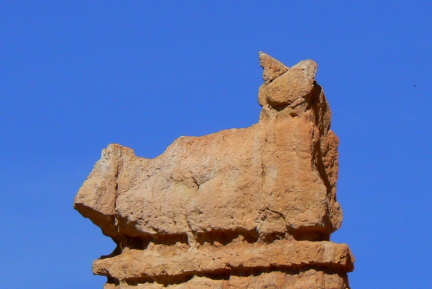
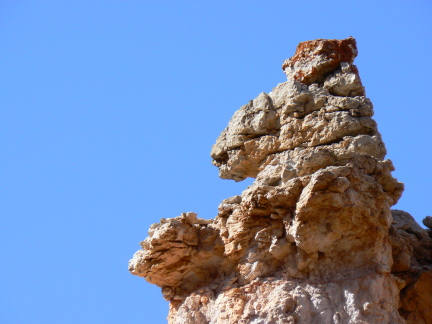
Bryce has its share of anthropomorphic figures...

Wednesday, May 21, 2008

Utah Highway 12


It's not often that a road merits attention. Some, like the Cabot Trail and the Pacific Coast Highway are fairly well-known. Utah's SR 12 is another such road. Lots to see.

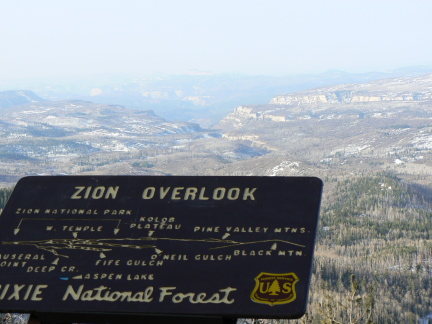
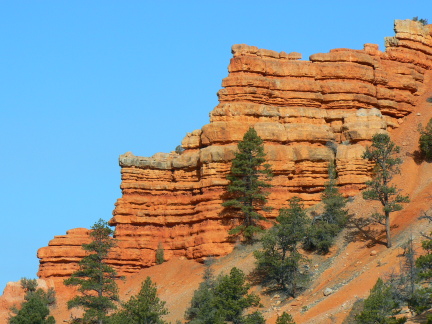
I actually drove only a relatively modest portion of it, only covering the western 30 miles or so of it. Most of these pictures here are from the Red Canyon area immediately west of Bryce Canyon. The first picture is from slightly further west, on Utah SR 14, which is the main road passing to the north of Zion National Park. The forest service helpfully put up a sign at the pullout to show how much of the Zion area could be seen from about 9000 feet.

Tuesday, May 13, 2008

Zion National Park: Kolob Canyon

I spent 2 1/2 days hiking around the lower reaches of Kolob Canyon, in the northern section of Zion National Park. (Apparently the upper reaches of the canyon are a real canyoneering challenge, not without some risks. Fear not, I wasn't there.)


The principal hiking feature to see in this canyon is the Kolob Arch, one of the longest arches in the world. It's a 13-mile round trip to the arch, and many people make that trek in one day. I opted to do some camping, since that would give some time to explore further up the canyon.

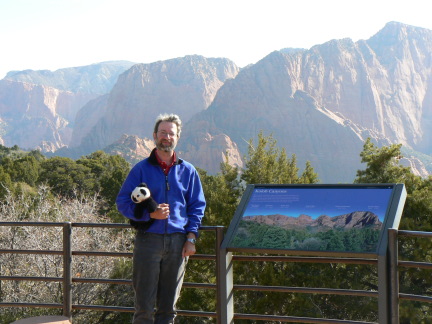
I started the day by driving along the road that provides pullouts and views of the lower canyon areas, where an obliging ranger captured me and Bear.


The first 3 miles or so of the hike are a trek down to Kolob Creek, and a set of falls.


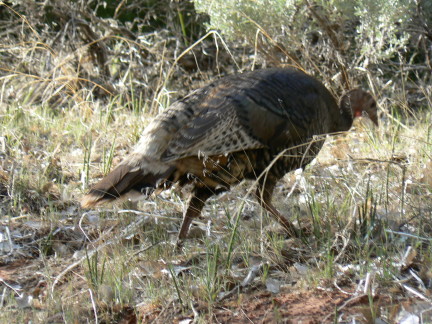
After another 2.5 miles, I reached my assigned camp site, and proceeded from there the last mile up to the arch, which is in a side canyon feeding into Kolob Canyon. In addition to the arch itself, you can see arches-under-construction in various places. You can also see turkeys in the underbrush...


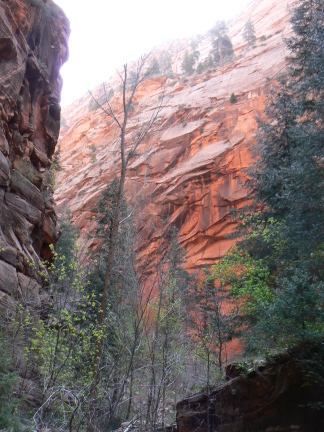
The next day I headed further up Kolob Canyon, the goal being the ominously-named Bear Trap Canyon. Fear not, Bear managed to enjoy the hike, in spite of many stream crossings. (I was unable to capture Bear cavorting in the falls -- let's just say that Bear is a bit water-averse, and there were no dry spots nearby that could be used to effect.) The side canyon was so narrow that there was still snow present in it...


The rest of the afternoon was spent hunting for wildlife...