Lima is a difficult city to navigate. There is no subway; there are no organized, documented, bus routes. Taxis are risky; gringos are likely to be scammed, and you have to negotiate prices. I had arranged transport to the hotel ahead of time (the round trip costing more than one night's hotel room), and the driver described how people were often charged as much as $100 for what should be a $10-15 ride.
This is the cost of not preparing (knowing what things ought to cost).
I walked from the hotel in the upscale, fairly safe, Miraflores area of Lima to nearby San Isidro, where there is a pre-Inca ruin called Huaca Huallamarca. This is basically a first-millenium pyramid made of mud bricks. The guide did a good job describing the site and its uses, as a political and religious center of the peoples there at time.
From there I went on what turned into a longer-than-intended walk up to the center of Lima. I should have taken a bus, but the bus system is confusing. Buses have locations, which are usually street names, but sometimes place names, printed on them. If you know where the roads go, you can know which bus to take to get where you're going. I was a bit gun-shy, so decided to walk. And walk. And walk. After 1+ hour, I reached Lima's Museo des Artes, which features some pre-Columbian pottery, textiles, and metal work, and a larger array of paintings from the colonial period to modern times. Lighting was not always great, and there were spotty English descriptions of the older stuff.
Another 40 minutes of walking, which included passing by some nice colonial architecture, brought me to the center of Lima, the Plaza de Armas, which is the typical Latin main square, full of bustle, and a surrounded by old buildings.
A few short blocks from the plaza is the Monastery of San Francisco, which reminded very much of things that I saw in Spain last year, except more run-down. Tile work (probably using tile from Spain) and woodwork were very similar to the Old World things I saw. The neat part of the tour was the catacombs, where archaeologists have cataloged bodies going all the way back to the early colonial days -- the monastery crypt was one of the first burial grounds of the colony.
Back near the plaza, I finally decided to brave the buses and caught a bus that dropped me (after about 45 diesel-choked minutes) near my hotel.
The next day (yesterday!) brought an early start to reach the airport, and an uneventful pair of flights home.
There's no place like home.

Showing posts with label peru. Show all posts
Showing posts with label peru. Show all posts
Wednesday, December 13, 2006
Home sweet home
My time in Lima was, well, somewhat uninspiring.


Tuesday, November 21, 2006
The road to Chile
Once again, I had an early start. This time it was to catch a 7:30AM bus from Arequipa to the Peruvian border town of Tacna. This went without a hitch -- the bus left pretty much right on time. We got to see several movies on the bus, including The Terminal, which I had not seen before (Spielberg directs Tom Hanks as a Bulgarian stuck in Newark Airport's no-man's-land). Also some silly surf movie, and another silly teen romantic comedy. Rah. The movies were a welcome respite from the landscape, which was basically piles of sand. Seriously. In the desert Southwest of America, there is life in the desert. The desert here looked like it was completely devoid of life.
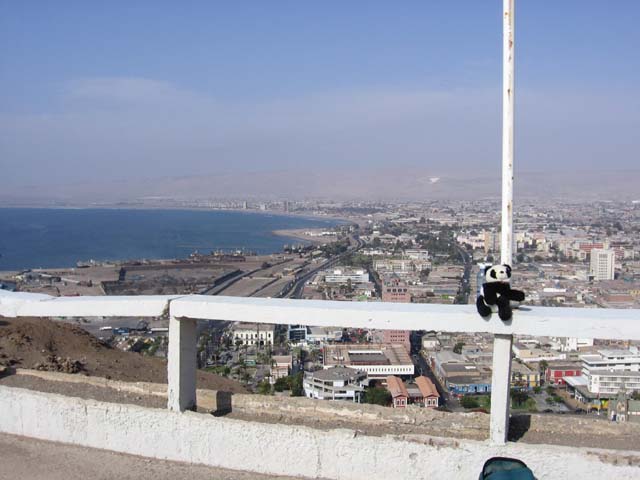
Upon arrival in Tacna, the hucksterism for transport to Arica in Chile began the moment I got off the bus. I daresay it happened before I even got out the door.
I paid 18 soles (about $6) for a "collectivo" taxi to Arica. I should have haggled, but was sick and tired of haggling to save $1-1.50. There are buses that make the run, and there are these collectivos, which are mostly decommissioned US police cars (or their near twins). I highly recommend taking the collectivo, even though it costs more than the bus, since you clear border formalities more quickly. One traveler who had crossed this border took a bus, and it was delayed over 1 hour because some idiot had drugs, something neither side looks kindly on. My collection of 5 passengers went through Peruvian formalities fairly smoothly, but the young couple from Ecuador were stopped at the Chilean border (for reasons unknown to me, my Spanish isn't good enough to follow what the driver told the others), so we went on without them.
The entire drive, including border formalities, from Tacna to Arica took a little over 1 hour. This was aided by the driver, who drove really fast down the straight 2-to-4 lane road. How fast? Dunno, his speedo was broken.
I booked into a place recommended by my Rough Guide, but I don't like it, a bit of a dump, and they shut off the water at night (which didn't help when my traveler's disease resurfaced early this morning...)


Hasta luego!

Upon arrival in Tacna, the hucksterism for transport to Arica in Chile began the moment I got off the bus. I daresay it happened before I even got out the door.
I paid 18 soles (about $6) for a "collectivo" taxi to Arica. I should have haggled, but was sick and tired of haggling to save $1-1.50. There are buses that make the run, and there are these collectivos, which are mostly decommissioned US police cars (or their near twins). I highly recommend taking the collectivo, even though it costs more than the bus, since you clear border formalities more quickly. One traveler who had crossed this border took a bus, and it was delayed over 1 hour because some idiot had drugs, something neither side looks kindly on. My collection of 5 passengers went through Peruvian formalities fairly smoothly, but the young couple from Ecuador were stopped at the Chilean border (for reasons unknown to me, my Spanish isn't good enough to follow what the driver told the others), so we went on without them.
The entire drive, including border formalities, from Tacna to Arica took a little over 1 hour. This was aided by the driver, who drove really fast down the straight 2-to-4 lane road. How fast? Dunno, his speedo was broken.
I booked into a place recommended by my Rough Guide, but I don't like it, a bit of a dump, and they shut off the water at night (which didn't help when my traveler's disease resurfaced early this morning...)


Hasta luego!
Finally, a few pictures
First we have the traditional view of Macchu Pichu.


And now we have me standing in front of some vicuñas.
You may have to look a bit carefully, they blend pretty well into the background.
That's it for now. More will have to wait for another time.

Monday, November 20, 2006
Colca Cañon, and tour group logistics
Colca Cañon was once thought to be the deepest canyon in the world. It has points that are more than 3000 meters from rim to bottom. However, measurements taken in recent years have placed the neighboring Cotahuasi Cañon even deeper.
But Colca Cañon currently is more accessible, and makes a decent two or more day outing from Arequipa.
The main town in the Canyon is Chivay, which lies at about 3500m (compared to IMG_128Arequipa at 2300m). It was about a four-hour drive, with a tour group of 11. I was the only native English-speaker. There were 4 Spaniards, some of whom spoke some English, 4 Peruvians (ditto), and 2 Poles, whose English was pretty good. (They were both high tech workers/business people.) The bus first passes through a reserve where the endangered vicuña is to be seen. (It's a relative of the llama and alpaca, for those keeping score. It's wool is supposedly even better than alpaca, but is .rare and expensive, since the animals are generally protected.)I


After snapping some vicuña pictures, we went over the 4910m pass before descending to Chivay. I believe this pass was the highest point I reached in Peru. Noticeable hints of altitude (headache and shortness of breath) were helped slightly by sucking on "Coca Candy" bonbons. First two ingredients (before even sugar!) were, you guessed it, coca derivatives. I may bring a sample home.


At one point the van stopped for a rest break and pictures that begged for a panorama (linked picture is 2Mb, and even larger).

The evening in Chivay exposed differing tour group logistics. Some people pay "package tour" prices that are all-inclusive, and some don't. Most of the group was staying at the Colca Lodge, a fairly tony affair in a wide spot of the canyon. I (on the budget plan) was put into a cheap but effective place in the center of Chivay, and also ate dinner in the company of the over-tired guide. The dinner included (for tips) a music-and-dance show.
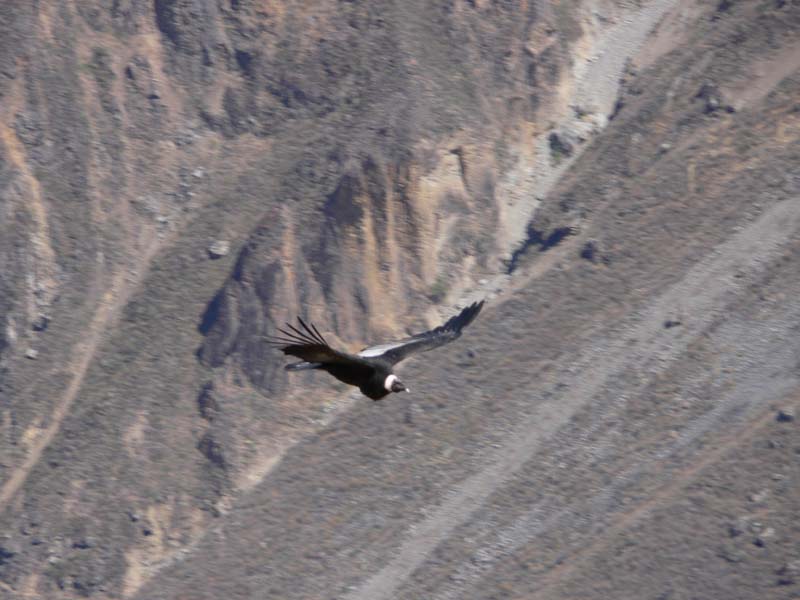
The next day dawned early and clear. After reassembling the group, we traveled up some very bumpy roads up on the canyon sides to a place called Cruz del Condor. Between 9 and 9:30 every morning, Andean condors nesting in the area wake up and ride thermals into the sky. It's a quite impressive site.


The Polish guy took some really great pictures, which he shared.


Did I mention that the canyon also has some of the oldest South American terracing? It dates back well before the Inca. Very neat stuff.


The rest of the second day was basically occupied by driving back to Arequipa, basically the same way we came.
Back at my hotel in Arequipa, I met a gent (hi Mark!) who's been world-traveling for the last five years, after dropping out of the rat race in the US. He had some interesting opinions on what I should do with the remainder of my time here in SA. He and I both gave advice to a quartet of Swiss 20-somethings who had only recently gotten off the plane.
Coming soon, an account of my border crossing between Peru and Chile.
Hasta luego!
But Colca Cañon currently is more accessible, and makes a decent two or more day outing from Arequipa.
The main town in the Canyon is Chivay, which lies at about 3500m (compared to IMG_128Arequipa at 2300m). It was about a four-hour drive, with a tour group of 11. I was the only native English-speaker. There were 4 Spaniards, some of whom spoke some English, 4 Peruvians (ditto), and 2 Poles, whose English was pretty good. (They were both high tech workers/business people.) The bus first passes through a reserve where the endangered vicuña is to be seen. (It's a relative of the llama and alpaca, for those keeping score. It's wool is supposedly even better than alpaca, but is .rare and expensive, since the animals are generally protected.)I


After snapping some vicuña pictures, we went over the 4910m pass before descending to Chivay. I believe this pass was the highest point I reached in Peru. Noticeable hints of altitude (headache and shortness of breath) were helped slightly by sucking on "Coca Candy" bonbons. First two ingredients (before even sugar!) were, you guessed it, coca derivatives. I may bring a sample home.


At one point the van stopped for a rest break and pictures that begged for a panorama (linked picture is 2Mb, and even larger).

The evening in Chivay exposed differing tour group logistics. Some people pay "package tour" prices that are all-inclusive, and some don't. Most of the group was staying at the Colca Lodge, a fairly tony affair in a wide spot of the canyon. I (on the budget plan) was put into a cheap but effective place in the center of Chivay, and also ate dinner in the company of the over-tired guide. The dinner included (for tips) a music-and-dance show.
The next day dawned early and clear. After reassembling the group, we traveled up some very bumpy roads up on the canyon sides to a place called Cruz del Condor. Between 9 and 9:30 every morning, Andean condors nesting in the area wake up and ride thermals into the sky. It's a quite impressive site.


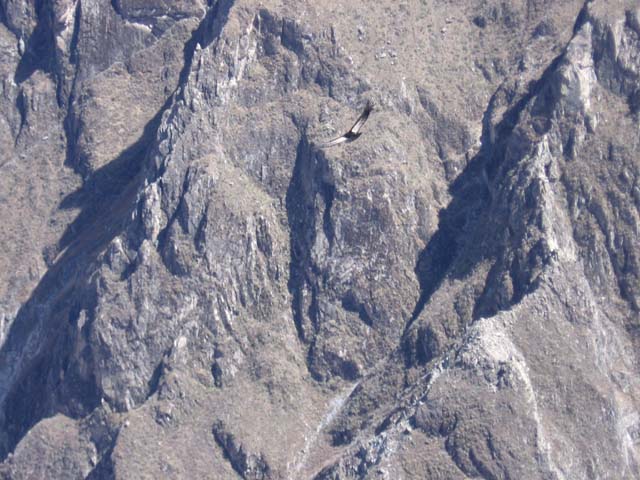

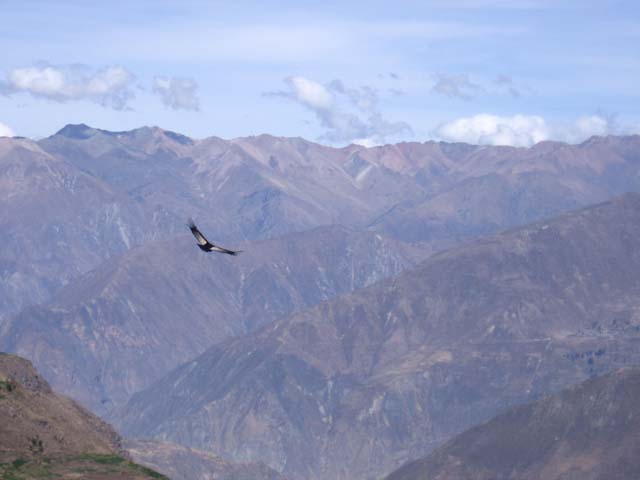


The Polish guy took some really great pictures, which he shared.


Did I mention that the canyon also has some of the oldest South American terracing? It dates back well before the Inca. Very neat stuff.


The rest of the second day was basically occupied by driving back to Arequipa, basically the same way we came.
Back at my hotel in Arequipa, I met a gent (hi Mark!) who's been world-traveling for the last five years, after dropping out of the rat race in the US. He had some interesting opinions on what I should do with the remainder of my time here in SA. He and I both gave advice to a quartet of Swiss 20-somethings who had only recently gotten off the plane.
Coming soon, an account of my border crossing between Peru and Chile.
Hasta luego!
Sunday, November 19, 2006
Arequipa
I spent Friday in Arequipa, mainly as an "admin" day. There were only a few things to attract my attention away from (1) getting laundry done (2) booking a Colca Canyon tour, and (3) getting a bus ticket to Tacna, which is the Peruvian border town en route to Arica, my next stopping point after finishing up in Arequipa and Colca Canyon.


Arequipa is home to a significant collection of Inca-period child sacrifices. Several (including a fairly famous Juanita) were found near the summit of a nearby volcano. It turns out that the neighboring volcano to that one was quite active during the time of the great Inca leader Pachacutec, and it was quite likely that these sacrifices were made to the angry Apus who were spewing ash.
After a fairly quiet and relaxing day, I (once again) had an early start on Saturday for the Colca Canyon tour.


Arequipa is home to a significant collection of Inca-period child sacrifices. Several (including a fairly famous Juanita) were found near the summit of a nearby volcano. It turns out that the neighboring volcano to that one was quite active during the time of the great Inca leader Pachacutec, and it was quite likely that these sacrifices were made to the angry Apus who were spewing ash.
After a fairly quiet and relaxing day, I (once again) had an early start on Saturday for the Colca Canyon tour.
Friday, November 17, 2006
The Inca Sacred Valley Tour
The day after returning from the Inca Trail trek, I boarded a bus with a number of more regular turistas to tour the Sacred Valley. This is basically the Urubamba River valley from the town of Pisac, north of Cusco, to Ollantaytambo further downstream.


The first stop was the market at Pisac town. If this sounds to you mostly like a tourist trap, it is. The annoying thing is that 20 minutes above Pisac town is an Inca ruin, which "there is not time to see". Sigh. It seems like all the stuff that was for sale here was similar to what was for sale elsewhere (Cusco, etc).
Then it was off to lunch in the town of Urubamba. We narrowly avoided getting caught behind one of many political events there. Since the regional elections are Sunday, there is a very high level of political activity going on everywhere. Both Wednesday and Thursday more than one of Cusco's plazas was taken over by rallies.
But I digress. Lunch was a buffet-style affair with "tipico Andino" food. How this includes ceviche (a Peruvian seafood soup specialty) escapes me. The dining was accompanied by (1) a sort of "music minus one" recording and (2) a few musicians playing traditional instruments. The tunes were not traditional (unless you consider the Beatles to be traditional).
Ollantaytambo (Oh-yan-tie-tum-bo) was the highlight of the tour, with (not really surprising to me) not enough time allocated to it. The guide, a Quechua who claimed to be from Ollantaytambo, was quite enthusiastic and somewhat informative. (He also claims to have run the Inca Trail in 4.5 hours. I believed that part.) This particular site was left unfinished when the Spanish arrived, so a good deal of the Inca construction technology was exposed to view.


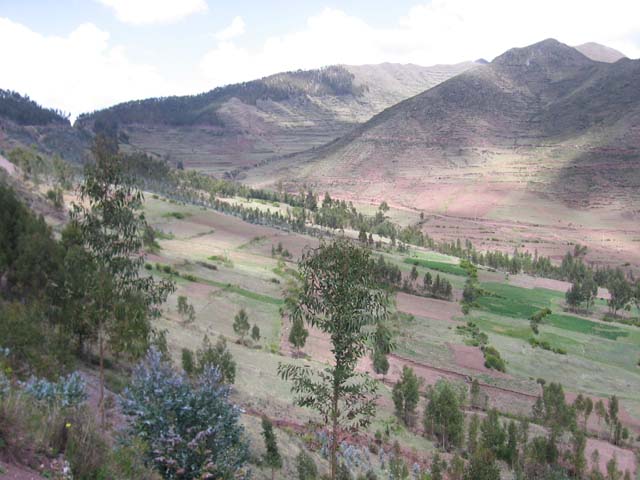
From Ollantaytambo, the bus proceeded on toward the next stop, Chinchero. En route, the lighting was so nice, the bus driver stopped for picture-taking. Note that the first two thumbnails here link to large (2-3Mb) images, since these are panoramas.


The last stop was Chinchero, a town at about 4000 meters that is still occupied, and largely built in Inca foundations. Imagine how much stuff was for sale there. The guide was really good here, because he was able to communicate how designs and patterns varied from one part of the highlands to another. To him, gringos all look alike, but he can tell where highlanders are from by the patterns they wear.
The day concluded with a taxi trip to the bus station, where I boarded the night bus to Arequipa. This is not your typical Greyhound. They have attendants, serve food and drink, and showed a movie (which I ignored, as I was vainly trying to sleep).
So I'm now in Arequipa, in the shadow of the bubbling El Misti volcano. Tomorrow (Saturday) I head off on a 2-day tour of the Colca Cañon, which is quite nearly the world's deepest (Cotihuasa next door is slightly deeper). If there's Internet in Chivay, I may post from there. Otherwise, it'll just have to wait until I get back to Arequipa.
Hasta luego!



The first stop was the market at Pisac town. If this sounds to you mostly like a tourist trap, it is. The annoying thing is that 20 minutes above Pisac town is an Inca ruin, which "there is not time to see". Sigh. It seems like all the stuff that was for sale here was similar to what was for sale elsewhere (Cusco, etc).
Then it was off to lunch in the town of Urubamba. We narrowly avoided getting caught behind one of many political events there. Since the regional elections are Sunday, there is a very high level of political activity going on everywhere. Both Wednesday and Thursday more than one of Cusco's plazas was taken over by rallies.
But I digress. Lunch was a buffet-style affair with "tipico Andino" food. How this includes ceviche (a Peruvian seafood soup specialty) escapes me. The dining was accompanied by (1) a sort of "music minus one" recording and (2) a few musicians playing traditional instruments. The tunes were not traditional (unless you consider the Beatles to be traditional).
Ollantaytambo (Oh-yan-tie-tum-bo) was the highlight of the tour, with (not really surprising to me) not enough time allocated to it. The guide, a Quechua who claimed to be from Ollantaytambo, was quite enthusiastic and somewhat informative. (He also claims to have run the Inca Trail in 4.5 hours. I believed that part.) This particular site was left unfinished when the Spanish arrived, so a good deal of the Inca construction technology was exposed to view.


From Ollantaytambo, the bus proceeded on toward the next stop, Chinchero. En route, the lighting was so nice, the bus driver stopped for picture-taking. Note that the first two thumbnails here link to large (2-3Mb) images, since these are panoramas.


The last stop was Chinchero, a town at about 4000 meters that is still occupied, and largely built in Inca foundations. Imagine how much stuff was for sale there. The guide was really good here, because he was able to communicate how designs and patterns varied from one part of the highlands to another. To him, gringos all look alike, but he can tell where highlanders are from by the patterns they wear.
The day concluded with a taxi trip to the bus station, where I boarded the night bus to Arequipa. This is not your typical Greyhound. They have attendants, serve food and drink, and showed a movie (which I ignored, as I was vainly trying to sleep).
So I'm now in Arequipa, in the shadow of the bubbling El Misti volcano. Tomorrow (Saturday) I head off on a 2-day tour of the Colca Cañon, which is quite nearly the world's deepest (Cotihuasa next door is slightly deeper). If there's Internet in Chivay, I may post from there. Otherwise, it'll just have to wait until I get back to Arequipa.
Hasta luego!
Subscribe to:
Posts (Atom)


