While I was on the Earthwatch dig in Spain, we often listened to CDs in the van. One of them I really liked, so I tracked it down.
When I put it on here, I was immediately transported back to that van in Spain.
Thanks, Luis.
Showing posts with label spain. Show all posts
Showing posts with label spain. Show all posts
Saturday, September 10, 2005


Sunday, September 04, 2005
Toledo, and how to catch a train
Toledo is a medieval city a short (1+ hour) train ride from Madrid. It is situated on some high ground near the confluence of two rivers.


I basically just wandered about the city, which is a maze of narrow streets, occasionally punctuated by small plazas. There is one main largish plaza which I suppose qualifies as the "center" of town, even though it's near one end of the town, and another decent-sized one near the cathedral.
Toledo is known for having a large number of paintings by (and a museum featuring the works of) the painter known as El Greco. Since I'm not a much of a fan of his, I didn't pursue these possibilities. In fact, the only attraction of sorts I went into was the local mezquita (mosque converted to church).


The other surprise was that Toledo has a somewhat interesting train station. It appears to have a church as part of the structure, but there's a fair amount of typical mudejar styling at work there.


(Go figure, stained glass in a small train station.)
I then had a bit of a travel near-ooops. The same day I went to Toledo, I was also scheduled for the night train from Madrid to Paris. However, I had (stupidly?) neglected to remember exactly when the night train left Madrid. I returned from Toledo to Madrid, and spent some more time walking in Madrid (and having a bite at Ben and Jerry's). I finally returned to hotel around 6:30 to pick up my bags and head (early, I thought) to the train station.
Train departure time was: 7:00
Uh-oh.
I'm glad it was Sunday, and I was right near a taxi queue. I'd have never made it in time on the subway. The train pulled out 5 minutes after I got on board.
Adios, España.


I basically just wandered about the city, which is a maze of narrow streets, occasionally punctuated by small plazas. There is one main largish plaza which I suppose qualifies as the "center" of town, even though it's near one end of the town, and another decent-sized one near the cathedral.
Toledo is known for having a large number of paintings by (and a museum featuring the works of) the painter known as El Greco. Since I'm not a much of a fan of his, I didn't pursue these possibilities. In fact, the only attraction of sorts I went into was the local mezquita (mosque converted to church).


The other surprise was that Toledo has a somewhat interesting train station. It appears to have a church as part of the structure, but there's a fair amount of typical mudejar styling at work there.


(Go figure, stained glass in a small train station.)
I then had a bit of a travel near-ooops. The same day I went to Toledo, I was also scheduled for the night train from Madrid to Paris. However, I had (stupidly?) neglected to remember exactly when the night train left Madrid. I returned from Toledo to Madrid, and spent some more time walking in Madrid (and having a bite at Ben and Jerry's). I finally returned to hotel around 6:30 to pick up my bags and head (early, I thought) to the train station.
Train departure time was: 7:00
Uh-oh.
I'm glad it was Sunday, and I was right near a taxi queue. I'd have never made it in time on the subway. The train pulled out 5 minutes after I got on board.
Adios, España.
Friday, September 02, 2005
Madrid, mostly museums
I had planned to spend most of my time in Madrid alternating between museums and other activities, hopefully including working on the blog. But my inability to find a place in Madrid where I could actually upload pictures is part of the reason I'm about a week behind in describing everything. Never fear, the blog is catching up to reality.
Over three days (including the 1/2 day preceding the daytrip to Cercedilla) I visited the Museo del Prado and the Thyssen-Bornemisza Museum.
The Prado is basically Spain's national gallery, and has a great many important Spanish paintings, and more than a few important Dutch paintings (courtesy of Spain's long rule over the Low Countries). It also has Hieronymus Bosch's Garden of Earthly Delights, and some very nice Roman-era sculpture. I don't normally photograph in museums, but I liked this guy:


You can see all of the Prado in 4-6 hours -- I spread this over two days.
The Thyssen Museum is the repository for what was once a private collection, amassed by a German-Hungarian business/noble family. (The Thyssen name is well-known in Europe as a major industrial concern. This is an outgrowth of the family business, which was originally steel.) The collection presented here includes separate sections for the Baron's and Baroness' collections, and it is a real gem of a collection. All of the works are in amazingly well-kept condition, and, unlike the Prado and other large public museums, was remarkably uncrowded. If you are an art lover in Madrid, you should not miss this collection.
The Thyssen is also a 4-6 hour affair, again spread over two days.
Since I was unable to blog effectively in Madrid, I of course chose to walk.

 The Palacio Real (Royal Palace)
 Street Scene


 A day in the park.
While staying in Madrid, I also day-tripped to Toledo. (No, NOT the one in Ohio!)
Over three days (including the 1/2 day preceding the daytrip to Cercedilla) I visited the Museo del Prado and the Thyssen-Bornemisza Museum.
The Prado is basically Spain's national gallery, and has a great many important Spanish paintings, and more than a few important Dutch paintings (courtesy of Spain's long rule over the Low Countries). It also has Hieronymus Bosch's Garden of Earthly Delights, and some very nice Roman-era sculpture. I don't normally photograph in museums, but I liked this guy:


You can see all of the Prado in 4-6 hours -- I spread this over two days.
The Thyssen Museum is the repository for what was once a private collection, amassed by a German-Hungarian business/noble family. (The Thyssen name is well-known in Europe as a major industrial concern. This is an outgrowth of the family business, which was originally steel.) The collection presented here includes separate sections for the Baron's and Baroness' collections, and it is a real gem of a collection. All of the works are in amazingly well-kept condition, and, unlike the Prado and other large public museums, was remarkably uncrowded. If you are an art lover in Madrid, you should not miss this collection.
The Thyssen is also a 4-6 hour affair, again spread over two days.
Since I was unable to blog effectively in Madrid, I of course chose to walk.

 The Palacio Real (Royal Palace)
 Street Scene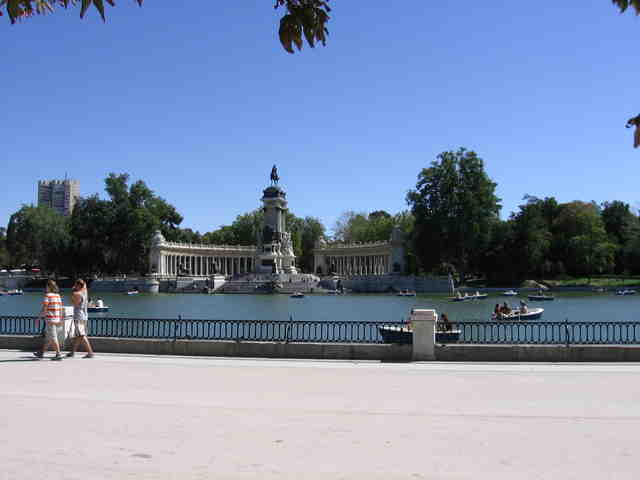

 A day in the park.
While staying in Madrid, I also day-tripped to Toledo. (No, NOT the one in Ohio!)
Ciudad Rodrigo
Ciudad Rodrigo is a small city near (perhaps 20km from) the Portugese border. It is best known for the old, completely walled city. I took a bus from Salamanca.
 This part of Spain is flat.
 I mean, really flat.
 Kinda pretty, even if it is flat.
The old city itself did not present itself in an imposing way (unlike, say Toledo, which we'll see later), but did lend itself to a 1/2 day of walking and picture-snapping.


I returned to Salamanca for the night, and left early to catch a train back to Madrid. (In this case "early" translates to a 7:45AM train, preceded by a 25 minute walk under load from my 12-Euro room.)
 The sun has barely risen.
 Nice (non-flat!) scenery between Salamanca and Madrid.
 This part of Spain is flat.
 I mean, really flat.
 Kinda pretty, even if it is flat.
The old city itself did not present itself in an imposing way (unlike, say Toledo, which we'll see later), but did lend itself to a 1/2 day of walking and picture-snapping.


I returned to Salamanca for the night, and left early to catch a train back to Madrid. (In this case "early" translates to a 7:45AM train, preceded by a 25 minute walk under load from my 12-Euro room.)
 The sun has barely risen.
 Nice (non-flat!) scenery between Salamanca and Madrid.
Thursday, September 01, 2005
Earthwatch Summary update
Alcoa has published diaries and photo galleries from its participants in the Earthwatch dig. I've added links to my Earthwatch Summary page. I've also added a link to the web site for the house where we stayed, which also has more pictures.
Wednesday, August 31, 2005
Salamanca, a real jewel
The city of Salamanca is one the real jewels of Spain. It features a nicely walkable old town, an absolutely stunning central plaza, and a vibrant culture courtesy of one of Europe's oldest universities.
I arrived here in early afternoon, and fairly quickly found what was to be the cheapest accomodations I stayed at: for 12 (twelve) euro, a single bedroom with shared bath. I had meals that cost more than this several times in my travels.
Along the way, I caught a glimpse of the Plaza Mayor.
 It's an imperfect panorama stitch job, but you get to see three sides of it.
This is a wonderful place to have a nice (if a bit overpriced) drink or meal, and just watch life unfold. The sandstone from which most of Salamanca is built is really neat stuff, and changes color as the day progresses.


 There's also a bull on the flagpole.
I spent hours walking the city, drinking in the architecture and the colors. I was reminded in some ways of Bath in England, which is almost all made of limestone in a somewhat similar color.


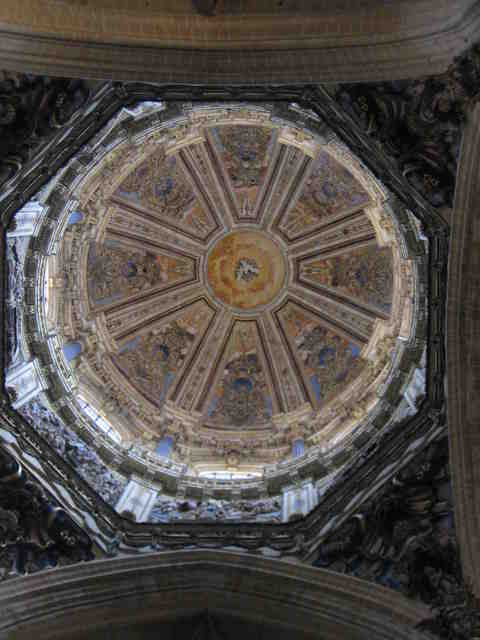
I also paid a brief visit into one of the cathedrals in town (there are actually several large churches, and I could never quite get straight which one was which).


One evening I was watching the sunset near one of the cathedrals when I witnessed a really cool phenomenon. As you can see, many buildings have small spires all over their tops. In the evening, flocks of heron (or other long-legged waterfowl, I'm not sure what) would circle about, still riding available thermals, and eventually settle down in various places on the roofs and spires of the buildings. By the time the show was done, it seemed like every spire had grown a bit longer, and a careful look might have been needed to see that the bird on top was not actually part of the building.
I didn't have the camera along when this happened. Ah well.
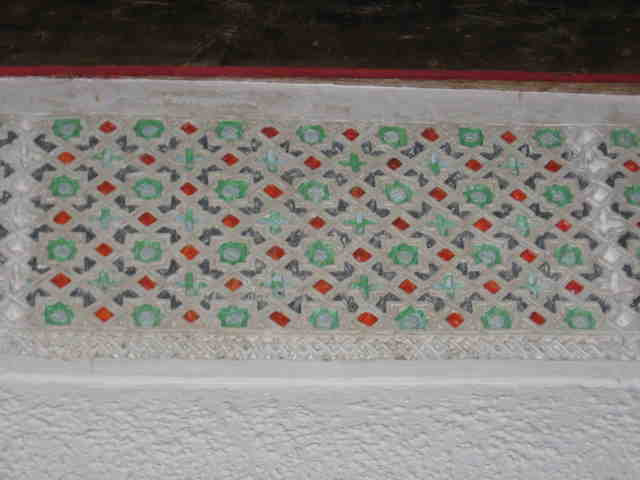
As previously mentioned, Salamanca is the site of one of Europe's oldest universities, founded in 1218. The original building housing the university is now a museum, and is home to some nice tilework.


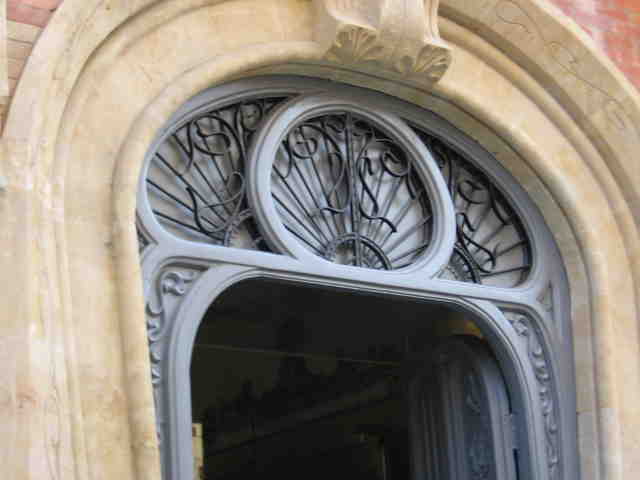
The only other thing of note I went to (there are a wealth of convents and monasteries that are open in some degree or other, into which I did not go) was the Museo Casa Lis, home to a fascinating collection of Art Noveau and Art Deco work. No pictures from the inside (not allowed...), but even the outside merited a few snaps.


While I was in Salamanca, I undertook a daytrip to Ciudad Rodrigo.
I arrived here in early afternoon, and fairly quickly found what was to be the cheapest accomodations I stayed at: for 12 (twelve) euro, a single bedroom with shared bath. I had meals that cost more than this several times in my travels.
Along the way, I caught a glimpse of the Plaza Mayor.
 It's an imperfect panorama stitch job, but you get to see three sides of it.
This is a wonderful place to have a nice (if a bit overpriced) drink or meal, and just watch life unfold. The sandstone from which most of Salamanca is built is really neat stuff, and changes color as the day progresses.
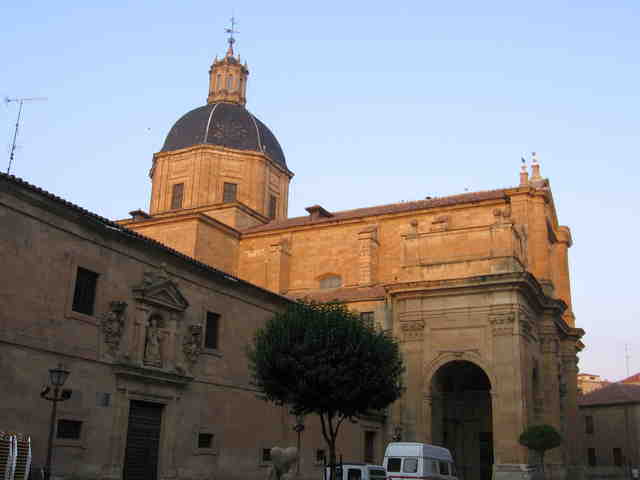

 There's also a bull on the flagpole.
I spent hours walking the city, drinking in the architecture and the colors. I was reminded in some ways of Bath in England, which is almost all made of limestone in a somewhat similar color.


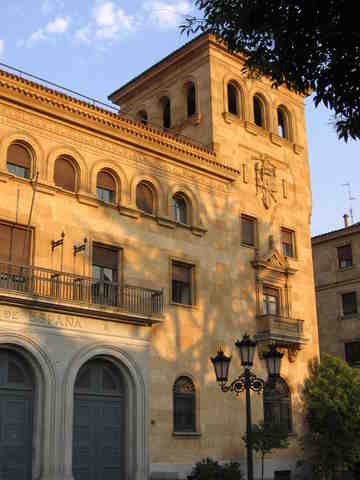
I also paid a brief visit into one of the cathedrals in town (there are actually several large churches, and I could never quite get straight which one was which).



One evening I was watching the sunset near one of the cathedrals when I witnessed a really cool phenomenon. As you can see, many buildings have small spires all over their tops. In the evening, flocks of heron (or other long-legged waterfowl, I'm not sure what) would circle about, still riding available thermals, and eventually settle down in various places on the roofs and spires of the buildings. By the time the show was done, it seemed like every spire had grown a bit longer, and a careful look might have been needed to see that the bird on top was not actually part of the building.
I didn't have the camera along when this happened. Ah well.
As previously mentioned, Salamanca is the site of one of Europe's oldest universities, founded in 1218. The original building housing the university is now a museum, and is home to some nice tilework.

The only other thing of note I went to (there are a wealth of convents and monasteries that are open in some degree or other, into which I did not go) was the Museo Casa Lis, home to a fascinating collection of Art Noveau and Art Deco work. No pictures from the inside (not allowed...), but even the outside merited a few snaps.

While I was in Salamanca, I undertook a daytrip to Ciudad Rodrigo.
Zaragoza
I was a bit disappointed by my visit to Zaragoza. Perhaps I had expected more. Perhaps I was suffering from homesickness (which I was, after six weeks on the road). In any event, I felt like it wasn't all I had thought it might be. It's largely a fairly modern city, not much of that narrow old-Europe feel to it.
Zaragoza does have a Cathedral, but I wasn't really overly impressed by it. Perhaps the churches seen in previous places just left me with that feeling.

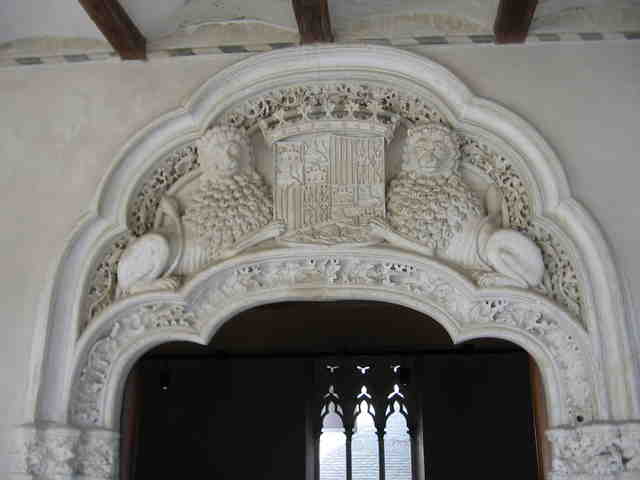
It does have a nice palace, with some nice mudejar touches, including some pretty cool ceilings.


There is also remains of the old Roman Forum (in a museum underground, similar to something I saw in Barcelona), and a fairly well-kept Roman theatre.
I did have a nice Italian meal on my last night in Zaragoza. The next morning, I caught a series of trains that left me in Salamanca (again without accomodation) in the early afternoon.
Friendly advice to people trying to make train reservations in Spain: the Renfe staff seem to be pretty bad at the idea of connecting trains. I inquired about travel from Zaragoza to Salamanca, and was advised everything was fully booked. In spite of this, I was able to travel between the two cities in about 5 1/2 hours: train to Madrid (plenty of seats), subway between Madrid-Atocha and Madrid-Chamartin, and train from Madrid to Salamanca (again, plenty of seats).
More friendly advice for the Renfe folks: train stations can be noisy, and communicating with your staff can be difficult if your native language is not Spanish. I had to call Renfe reservations (and speak with an English-speaker) to discover exactly what the issues were in my attempted travel plans.
Zaragoza does have a Cathedral, but I wasn't really overly impressed by it. Perhaps the churches seen in previous places just left me with that feeling.

It does have a nice palace, with some nice mudejar touches, including some pretty cool ceilings.



There is also remains of the old Roman Forum (in a museum underground, similar to something I saw in Barcelona), and a fairly well-kept Roman theatre.
I did have a nice Italian meal on my last night in Zaragoza. The next morning, I caught a series of trains that left me in Salamanca (again without accomodation) in the early afternoon.
Friendly advice to people trying to make train reservations in Spain: the Renfe staff seem to be pretty bad at the idea of connecting trains. I inquired about travel from Zaragoza to Salamanca, and was advised everything was fully booked. In spite of this, I was able to travel between the two cities in about 5 1/2 hours: train to Madrid (plenty of seats), subway between Madrid-Atocha and Madrid-Chamartin, and train from Madrid to Salamanca (again, plenty of seats).
More friendly advice for the Renfe folks: train stations can be noisy, and communicating with your staff can be difficult if your native language is not Spanish. I had to call Renfe reservations (and speak with an English-speaker) to discover exactly what the issues were in my attempted travel plans.
Subscribe to:
Posts (Atom)


