I attended Earthwatch's annual conference last Saturday. While it was a somewhat interesting affair, I suspect it would have been more fun had I gone (or met up with) others. My overall impression was that continuing connections with others (team members, scientists, etc) was happening all around me. While Early Man scientist Luis had intended to attend, the recent arrival of a new family member (congrats Luis!) seems to have upset his travel plans. Not surprising I guess.
The morning session consisted mainly of presentations by three scientists of their work. First Nithya Balaji talked about community education in southern India (Tamil Nadu). Next Ralph Riley talked about researching the critical role salmon plays in the Pacific Northwest, and about how local community (fishermen and loggers, for example) are included in their work. Then Chris Joyce talked about research into wetlands in Estonia, and how agriculture there had interestingly worked to increase biological diversity, and how abandonment of agriculture in Soviet times was leading to its decrease in this area.
After these presentations came a forum discussion that I decided to skip, preferring to spend some time in the "Global Village", where a variety of researchers had poster-style presentations of their work, and were themselves present (or had staff there) to answer questions about their work. I had an interesting chat with Karl Laumbach about his work in the American Southwest, digging up Pueblo artifacts.
Following a break for lunch came a presentation by two women, Carol Beckwith and Angela Fisher, who have done much work for National Geographic over the last 30 years, photographic and documenting indigenous African cultural traditions. A fascinating kaleidoscope of pictures and short video clips was studded with personal reminiscences and a sense of impending loss, especially in areas such as the southern Sudan, only now starting to recover from civil war, where they fear things they documented before the violence began may be irrevocably lost. They have lots of books available.
The afternoon session continued with three more scientist presentations. Marcos Santos talked about Brazil's need to better understand its marine mammal populations, given two challenges: (1) a relative lack of expertise (there are few marine scientists in Brazil, a significant problem given the amount of coastline and rivers), and (2) an increase in coastal development for tourism. Then Mark Huxham gave a spirited presentation on trying to restore damaged and destroyed mangrove stands in Kenya. The importance of these has come to the fore since the Indian Ocean tsunami... The final presentation was by Peter Kershaw, a leading researcher on the impact of global warming in the Arctic. The pictures and data he presented give a particularly compelling message, and he didn't mince the words that had political overtones. Are our politicians listening?
The final event of the afternoon was the keynote speech by E.O. Wilson, probably the world's leading expert on biodiversity. (Do you detect a theme here? Good.) He made some interesting observations on the relationship between habitat preservation and the amount of biodiversity that can be supported when habitat is reduced. If 90% of a habitat is lost, you can expect to lose 50% of the biodiversity, but it only gets worse from there.
If any Earthwatchers read this, did I miss you?
Showing posts with label earthwatch. Show all posts
Showing posts with label earthwatch. Show all posts
Wednesday, November 09, 2005


Tuesday, October 11, 2005
Road Trip, Illinois

I spent a few days visiting with Mom in Wheaton, IL. I've done this before, but have usually flown. On Tuesday we lovely afternoon in Chicago visiting this place:

The Oriental Institute is the University of Chicago's Near East Studies organization. Its museum has been under renovation for a number of years, so I never had chance to see it (also since we would be preoccupied by going to Chicago's other fine museums, like the Art Institute and the Field Museum. In any event, we had a great time there, spending considerably longer than either of us had anticipated. Anyone visiting Chicago should consider a visit there.
After that, we trundled up to the Navy Pier in Chicago, which is mostly a tourist trap and convention center. We went mainly to admire the contents of the Stained Glass Museum, which is essentially a free exhibit, skirting one side of the convention facilities, of a wide variety of stained glass windows.
On Wednesday, we again traveled into Chicago, this time to see the Art Institute's special exhibit on Toulouse-Lautrec, the well-known fin-de-siécle French artist. It was a well-staged exhibit, including many of his best-known works (quite a few of which were advertising posters, and are thus fairly recognizable). It also included vintage movie snippets from the time, as well as a later recreation of the Moulin Rouge scene from this movie.
While there, we met up for lunch with Karen, one the Earthwatch volunteers with whom I was in Spain. Hi Karen!
Saturday, September 10, 2005
Lágrimas Negras
While I was on the Earthwatch dig in Spain, we often listened to CDs in the van. One of them I really liked, so I tracked it down.
When I put it on here, I was immediately transported back to that van in Spain.
Thanks, Luis.
When I put it on here, I was immediately transported back to that van in Spain.
Thanks, Luis.
Thursday, September 01, 2005
Earthwatch Summary update
Alcoa has published diaries and photo galleries from its participants in the Earthwatch dig. I've added links to my Earthwatch Summary page. I've also added a link to the web site for the house where we stayed, which also has more pictures.
Tuesday, August 23, 2005
Granada, and the end of the Earthwatch team
The last day of the Earthwatch expedition was spent driving to Granada. The team had one last dinner together at a restaurant the scientists were familiar with. After this, people started to go separate ways. The younguns wanted to go clubbing. Several people, me included, wanted to find some good flamenco music. Under Luis' guidance, this we found.
Several of the team members had early departures the next morning, and decided to stay up all night. This is not such a bad idea in Spain, considering that dinner started around 10, and probably didn't end until 11:30. Of course, several of us decided to keep them company. This meant trekking to a place that was apparently a late bar frequented by the flamenco musicians after their gigs end. It closed somewhere around 3 or 4, I wasn't paying close attention. We ended up back at the hotel around 5, which worked for the early leavers, who needed to pack up and head out around 6. I ended up with about 2 hours sleep.
This decision cost at least me a chance to see the inside of the Alhambra, since getting going the next morning didn't work too good.
This I am pragmatic about. I missed out on one thing, but had a great time with a great bunch of people. Jair, Terrence, Gary, Bri, Luis, we had a grand time. I expect to be back in Spain, and I will get to the Alhambra.
As I said, the next morning was, well, poorly executed. Bri and Alicia and I had planned to meet to go to the Alhambra, but we weren't moving too fast, and missed out on morning tickets. I eventually said my goodbyes to all handy people, and wandered off into the city by myself, because I wanted to see more of it before catching a train to Sevilla in the late afternoon. The area I went into is called El Albaicin, and is the old quarter on the hillside opposite the Alhambra.
I wandered around, enjoying views that presented themselves, being generally depressed about being alone again, and digesting the experiences I'd had in the previous weeks.
The most significant thing I found was that I've been to closed in the high-tech world for the last too-many years. This is not really a surprising observation, but it was driven home in a particularly potent way, given the activities at hand and the diversity of folks involved.
The train ride to Sevilla from Granada is a particularly nice one -- very rural, picturesque desert scenes, and so forth.
Several of the team members had early departures the next morning, and decided to stay up all night. This is not such a bad idea in Spain, considering that dinner started around 10, and probably didn't end until 11:30. Of course, several of us decided to keep them company. This meant trekking to a place that was apparently a late bar frequented by the flamenco musicians after their gigs end. It closed somewhere around 3 or 4, I wasn't paying close attention. We ended up back at the hotel around 5, which worked for the early leavers, who needed to pack up and head out around 6. I ended up with about 2 hours sleep.
This decision cost at least me a chance to see the inside of the Alhambra, since getting going the next morning didn't work too good.
This I am pragmatic about. I missed out on one thing, but had a great time with a great bunch of people. Jair, Terrence, Gary, Bri, Luis, we had a grand time. I expect to be back in Spain, and I will get to the Alhambra.
As I said, the next morning was, well, poorly executed. Bri and Alicia and I had planned to meet to go to the Alhambra, but we weren't moving too fast, and missed out on morning tickets. I eventually said my goodbyes to all handy people, and wandered off into the city by myself, because I wanted to see more of it before catching a train to Sevilla in the late afternoon. The area I went into is called El Albaicin, and is the old quarter on the hillside opposite the Alhambra.
I wandered around, enjoying views that presented themselves, being generally depressed about being alone again, and digesting the experiences I'd had in the previous weeks.
The most significant thing I found was that I've been to closed in the high-tech world for the last too-many years. This is not really a surprising observation, but it was driven home in a particularly potent way, given the activities at hand and the diversity of folks involved.
The train ride to Sevilla from Granada is a particularly nice one -- very rural, picturesque desert scenes, and so forth.
Sunday, August 21, 2005
Earthwatch Summary
This is the series of posts I wrote describing my experiences in the Earthwatch "Early Man In Spain" expedition in the summer of 2005. Please read the introduction for more.
My thoughts
- Introduction
- Scientists and Staff
- Volunteers
- The typical day
- Information about Cueva Victoria
- Our outing to Orce
- Closing limericks
- Reflections
Other links
- Web Site for the house we stayed at (has pictures!)
- Alcoa's website about Early Man in Spain
- Terrence Trasatti's diary and photo gallery
- Luiz Simao's diary
- Jair Furnas' diary
- Cinco Minutos, kept by a 2002 volunteer, mainly about Orce.
- Hombre de Orce, Prof. Gibert's web site (en Español)
- A brief review from what appears to be a relatively unbiased source about the Orce Man find.
- TODO the main picture link for our team
Earthwatch limericks
I wrote these and left them in the guest book the scientists keep where many previous expedition members have also written (but not always in verse).
In a place called Victoria Cueva
We searched for fossiles nueva
No human remain
Was found there in Spain
But great fun was had on the wayva
At the site of Monte Mirall
The site of much mineral
We searched for quartz
Wearing dusty shorts
And Alfredo said
"Coordinate for them all"
The work was oft dusty and hot
But cerveza made it feel not
And keepaway at the beach
Twas fun, and did teach
The ladies to tie bikinis in double-knot
Whenever El Jefe said "Vamonos"
We fell into line just like dominoes
Except for Luis
Who'd lost his keys
Which made us late on the caminos
In a place called Cueva Victoria
We found fossils with great laboria
We'd much fun in the san'
Thanks to Gibert and his clan
And the great food of Jose and Antonia
In a place called Victoria Cueva
We searched for fossiles nueva
No human remain
Was found there in Spain
But great fun was had on the wayva
At the site of Monte Mirall
The site of much mineral
We searched for quartz
Wearing dusty shorts
And Alfredo said
"Coordinate for them all"
The work was oft dusty and hot
But cerveza made it feel not
And keepaway at the beach
Twas fun, and did teach
The ladies to tie bikinis in double-knot
Whenever El Jefe said "Vamonos"
We fell into line just like dominoes
Except for Luis
Who'd lost his keys
Which made us late on the caminos
In a place called Cueva Victoria
We found fossils with great laboria
We'd much fun in the san'
Thanks to Gibert and his clan
And the great food of Jose and Antonia
Saturday, August 20, 2005
Earthwatch, the so-called rest day
In the middle of the expedition, we had a day where we did not do any work. Despite this, it was a fairly tiring day, mostly because we spent alot of time in the vans.
We went on a road trip to Orce, where we were supposed to work originally. This was approximately a 3 hour drive in each direction, so you can picture 18 people in two vans cheek by jowl...
Orce sits in a desert basin that was once a lakebed. It is an absolutely beautiful piece of land. It was also unforgivingly hot the day we were there, which probably didn't make life any easier.
Our first stop was in the town of Orce itself, where there is a small museum, which, among other things, contains the "man of Orce" skull fragment.


Views of the Orce museum
We then toured a number of sites that the scientists had previously worked at, but are presently unable to get permission to work at. A principal stumbling block appears to be political in nature -- an official in charge of the permit-granting process has apparently been playing favorites in recent years, essentially pulling these sites away from this group of researchers. The government in Andalusía has apparently been single-party for sometime, which has led to a variety of problems that are somewhat predictable under those circumstances.
 Vente Micene, site where Orce skull fragment was found
In the middle of the tour of sites we stopped off at a local swimming hole for a swim, and lunch. The swimming hole is not actually a swimming pool, it is a spring-fed pond that's been surrounded by concrete. The water was cold, but the fish didn't seem to mind, and neither did those of us that went in, given the heat.


Swimming and other fun.
After touring the archaeological sites, we also toured the caves in which we would have stayed. This would have been really neat, except that there wasn't a pool right nearby (as at the house where we did stay).


Views in and around the cave residences
The day ended (except for the drive home toward dinner) with a visit to the Castel de Velez Blanco, a pseudo-fortification guarding one of the passes into the Orce valley.


We went on a road trip to Orce, where we were supposed to work originally. This was approximately a 3 hour drive in each direction, so you can picture 18 people in two vans cheek by jowl...
Orce sits in a desert basin that was once a lakebed. It is an absolutely beautiful piece of land. It was also unforgivingly hot the day we were there, which probably didn't make life any easier.
Our first stop was in the town of Orce itself, where there is a small museum, which, among other things, contains the "man of Orce" skull fragment.


Views of the Orce museum
We then toured a number of sites that the scientists had previously worked at, but are presently unable to get permission to work at. A principal stumbling block appears to be political in nature -- an official in charge of the permit-granting process has apparently been playing favorites in recent years, essentially pulling these sites away from this group of researchers. The government in Andalusía has apparently been single-party for sometime, which has led to a variety of problems that are somewhat predictable under those circumstances.
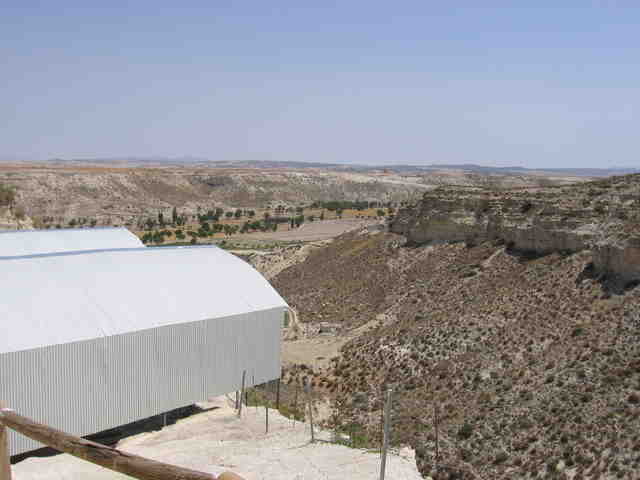 Vente Micene, site where Orce skull fragment was found
In the middle of the tour of sites we stopped off at a local swimming hole for a swim, and lunch. The swimming hole is not actually a swimming pool, it is a spring-fed pond that's been surrounded by concrete. The water was cold, but the fish didn't seem to mind, and neither did those of us that went in, given the heat.


Swimming and other fun.
After touring the archaeological sites, we also toured the caves in which we would have stayed. This would have been really neat, except that there wasn't a pool right nearby (as at the house where we did stay).


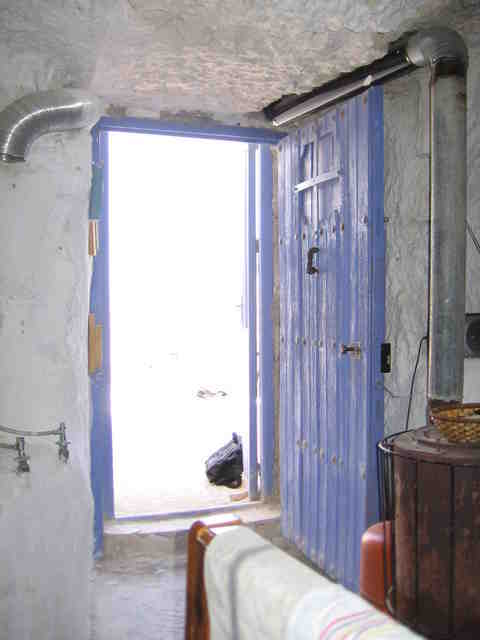
Views in and around the cave residences
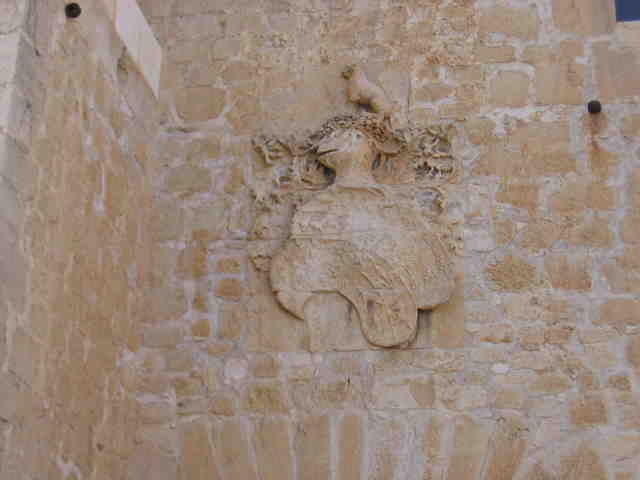
The day ended (except for the drive home toward dinner) with a visit to the Castel de Velez Blanco, a pseudo-fortification guarding one of the passes into the Orce valley.




Friday, August 19, 2005
Earthwatch, the volunteers
I very roughly categorize the volunteers into 4 categories:
students, teachers, Alcoa employees, and others
If one of you reads this and sees something wrong (or that you don't like), PLEASE let me know so I can correct it. I don't want to misrepresent anyone. (Also, if you know of better pictures of yourself, please get them to me.) Discretion prevents me from revealing ages of people who might not want them revealed or otherwise discussed. Let's say there was a significant diversity in age and maturity in the group.
Students
 Sara Duffy
- Karen's daughter, entering UMich for environmental studies (pictured on the left)
 Alex(andra) Khoobani
- student (junior?) at SUNY Purchase, journalism major (but looking to change it)
Julia Rappaport
- entering senior year in high school, Montclair NJ (pictured on the right)
Elyssa Osborne
- Middlebury College, english major
 Bri Lehman
- junior at Colorado U Boulder, art and anthropology
Teachers
Izela Guzman
- special ed teacher in Washington DC area, born to Mexican parents
 Alisa Scott
- lives in South Boston, works Brockton HS
 Wendy Farden
- teaches at international school in Lausanne Switzerland, an American from northern Minnesota (pictured on the right)
 Bill Peters
- teaches Whittier CA HS (pictured on the left)
Alcoa employees
 Terrence Trasatti
- IT consultant, Pittsburgh (Alcoa HQ)
 Jair Furnas
- HR rep, Washington state (Bellingham)
Luis Augusto Simao
- management/process consultant, Brazilian, beginning posting to Norway (pictured on the right)
Others
Mark Trumpler (that would be me)
- Boston, itinerant career-seeker
 Karen Duffy
- Chicago, art director for a publisher of children's magazines
Gary Geiger
- Seattle, bicycle messenger (also heading for school?) (pictured on the left)
These were the living arrangements:
There were four bathrooms, which were shared by all of us, including the scientists. There was also an outside shower, mainly for pool use, but also used to some extent for washing (in bathing suit).
A few observations on this fine collection of folks.
Quite a few people were given the expedition as some sort of grant or gift, and were required to keep diaries and other documentary evidence that they actually did something other than go to the beach and drink beer. (Need to get those really incriminating pictures of Jair from Terrence and put them here.)
Jair was the big man. If something large needed moving, he was the guy (although we found at least one rock the last day that we didn't think he could move, even if he was there.)
Terrence was the unofficial photographer, with by far the best camera gear. This did not stop lots of other people (including your humble scribe, of course) from using theirs as well. Terrence said he would set up a website where all can post pictures.
(Edit in link to main picture site. Also edit in pictures for those not yet covered.)
students, teachers, Alcoa employees, and others
If one of you reads this and sees something wrong (or that you don't like), PLEASE let me know so I can correct it. I don't want to misrepresent anyone. (Also, if you know of better pictures of yourself, please get them to me.) Discretion prevents me from revealing ages of people who might not want them revealed or otherwise discussed. Let's say there was a significant diversity in age and maturity in the group.
Students
 Sara Duffy
- Karen's daughter, entering UMich for environmental studies (pictured on the left)
 Alex(andra) Khoobani
- student (junior?) at SUNY Purchase, journalism major (but looking to change it)
Julia Rappaport- entering senior year in high school, Montclair NJ (pictured on the right)
Elyssa Osborne
- Middlebury College, english major
 Bri Lehman
- junior at Colorado U Boulder, art and anthropology
Teachers
Izela Guzman
- special ed teacher in Washington DC area, born to Mexican parents
 Alisa Scott
- lives in South Boston, works Brockton HS
 Wendy Farden
- teaches at international school in Lausanne Switzerland, an American from northern Minnesota (pictured on the right)
 Bill Peters
- teaches Whittier CA HS (pictured on the left)
Alcoa employees
 Terrence Trasatti
- IT consultant, Pittsburgh (Alcoa HQ)
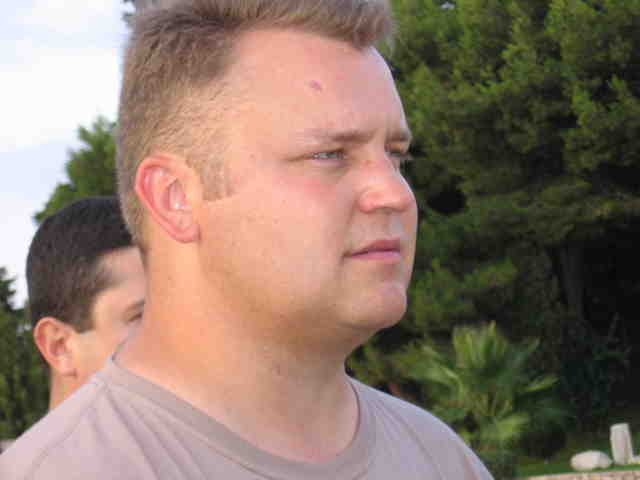 Jair Furnas
- HR rep, Washington state (Bellingham)
Luis Augusto Simao- management/process consultant, Brazilian, beginning posting to Norway (pictured on the right)
Others
Mark Trumpler (that would be me)
- Boston, itinerant career-seeker
 Karen Duffy
- Chicago, art director for a publisher of children's magazines
Gary Geiger- Seattle, bicycle messenger (also heading for school?) (pictured on the left)
These were the living arrangements:
- Alisa and Wendy
- Karen and Sara
- Mark and Terrence
- Julia, Elyssa, Alex, and Izela (aka the girls' room)
- Jair, Bill, and Luis (aka the guy's room)
- Bri and Gary
There were four bathrooms, which were shared by all of us, including the scientists. There was also an outside shower, mainly for pool use, but also used to some extent for washing (in bathing suit).
A few observations on this fine collection of folks.
Quite a few people were given the expedition as some sort of grant or gift, and were required to keep diaries and other documentary evidence that they actually did something other than go to the beach and drink beer. (Need to get those really incriminating pictures of Jair from Terrence and put them here.)
Jair was the big man. If something large needed moving, he was the guy (although we found at least one rock the last day that we didn't think he could move, even if he was there.)
Terrence was the unofficial photographer, with by far the best camera gear. This did not stop lots of other people (including your humble scribe, of course) from using theirs as well. Terrence said he would set up a website where all can post pictures.
(Edit in link to main picture site. Also edit in pictures for those not yet covered.)
Earthwatch, Cueva Victoria
The geological and human history of Cueva Victoria is somewhat interesting, and deserving of a post of its own. Hopefully if I get anything wrong, Luis will correct me.
The hills outside Cartagena are largely formed from limestone, and are thus prone to cave formation, since water penetrates the limestone and leaches it away, leaving openings behind. In the case of Cueva Victoria, this resulted in more than one occasion where the cave was exposed to the outside. During at least one of these exposures about 1-1.5 million years ago, a significant amount of erosion washed material rich in bones into the cave, filling (or nearly filling) the upper galleries. There are a wide variety of mostly mammalian bones in this material, on the order of 60-80 species have been found in the cave.
 Museum display case containing CV finds and background.
In the upper right you can see a "map" of the cave.
 We found horse molars (not attached to a jaw like these though).
 The Entrance
 The Entrance
There are narrow (1-1.5 foot wide) stairs going down.
 The Entrance (as seen from where we worked)
 Luis telling us about the cave.
 We did a lot of work in this area.

 A few vertebrae and other small bones there.


 Me digging out the carnivore femur(?).
 The team: Luis, Gary, me, Jair, Alisa, Alex, Alyssa, Bri
Cartagena itself was founded by Carthaginians, and taken over by Rome after the defeat of Carthage in the Punic Wars. It was a major port of the Iberian province, since the harbor was a good one, and easily defended.
 Cartagena's wall remnants
 Roman era lighthouse
View of the harbor (and of Karen and Sara Duffy)
Cartagena's Roman forum
It was also important due to the nearby mining activity. The Romans are estimated to have 40,000 people working in the mines. Of course, I now forget exactly which ores they were after, but I believe silver and copper are to be found. Cueva Victoria itself is a source of manganese ore, and I believe was not opened until the 19th century. The mining in this part of Spain was effectively stopped in 1992 as changes necessitated by Spain's entry into the EU put the mines out of business. This has had a significant effect on the economy of Cartagena, which is beginning to recast itself as a tourist destination.
When the miners worked Cueva Victoria, they used explosives to clear out portions of the mine, resulting in some large blocks of sedimentary deposits (breccia for the geologists reading this) lying on the floor of the cave. Some of these clearly have bones in them. The scientists are however reluctant to work on them, possibly because there are plenty of other, easier places to dig.
There is some detailed information in Spanish about Cueva Victora here. The Cinco Minutos is run by a volunteer from a previous year, that worked at the Orce site. It has some fairly nice pictures of the area (as will I when I can find a place that will let me upload them).
The hills outside Cartagena are largely formed from limestone, and are thus prone to cave formation, since water penetrates the limestone and leaches it away, leaving openings behind. In the case of Cueva Victoria, this resulted in more than one occasion where the cave was exposed to the outside. During at least one of these exposures about 1-1.5 million years ago, a significant amount of erosion washed material rich in bones into the cave, filling (or nearly filling) the upper galleries. There are a wide variety of mostly mammalian bones in this material, on the order of 60-80 species have been found in the cave.
 Museum display case containing CV finds and background.
In the upper right you can see a "map" of the cave.
 We found horse molars (not attached to a jaw like these though).
 The Entrance
 The Entrance
There are narrow (1-1.5 foot wide) stairs going down.
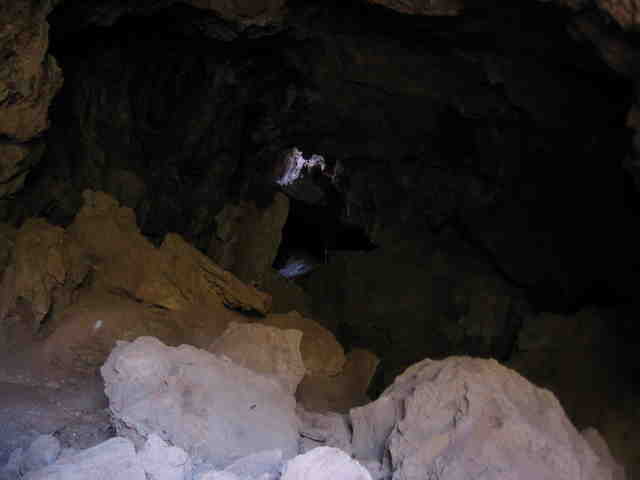 The Entrance (as seen from where we worked)
 Luis telling us about the cave.
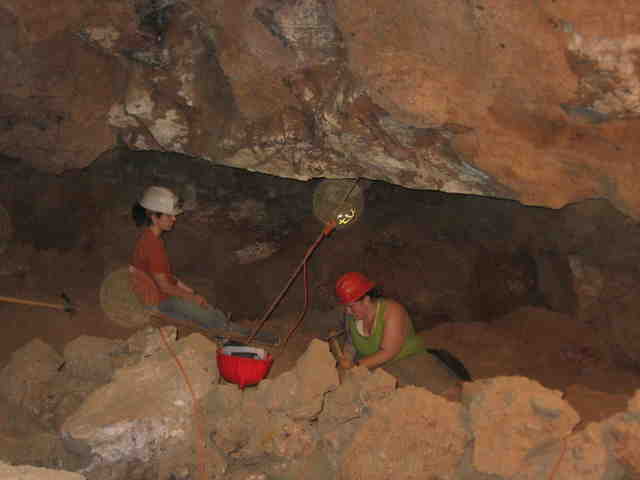 We did a lot of work in this area.
 A few vertebrae and other small bones there.
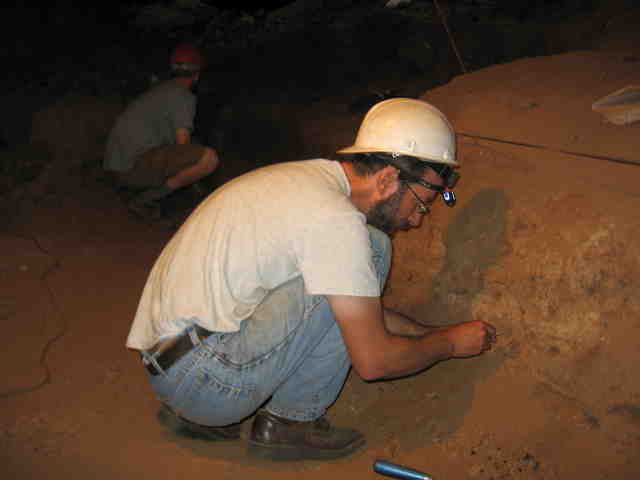
 Me digging out the carnivore femur(?).
 The team: Luis, Gary, me, Jair, Alisa, Alex, Alyssa, Bri
Cartagena itself was founded by Carthaginians, and taken over by Rome after the defeat of Carthage in the Punic Wars. It was a major port of the Iberian province, since the harbor was a good one, and easily defended.
 Cartagena's wall remnants
 Roman era lighthouseView of the harbor (and of Karen and Sara Duffy)Cartagena's Roman forum
It was also important due to the nearby mining activity. The Romans are estimated to have 40,000 people working in the mines. Of course, I now forget exactly which ores they were after, but I believe silver and copper are to be found. Cueva Victoria itself is a source of manganese ore, and I believe was not opened until the 19th century. The mining in this part of Spain was effectively stopped in 1992 as changes necessitated by Spain's entry into the EU put the mines out of business. This has had a significant effect on the economy of Cartagena, which is beginning to recast itself as a tourist destination.
When the miners worked Cueva Victoria, they used explosives to clear out portions of the mine, resulting in some large blocks of sedimentary deposits (breccia for the geologists reading this) lying on the floor of the cave. Some of these clearly have bones in them. The scientists are however reluctant to work on them, possibly because there are plenty of other, easier places to dig.
There is some detailed information in Spanish about Cueva Victora here. The Cinco Minutos is run by a volunteer from a previous year, that worked at the Orce site. It has some fairly nice pictures of the area (as will I when I can find a place that will let me upload them).
Subscribe to:
Posts (Atom)


