Friday, November 10, 2006

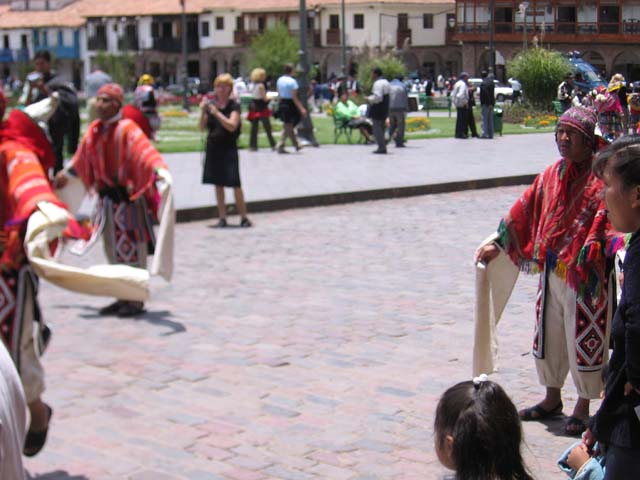
RW watches some native dancing

Yesterday morning, on the level portion of the Plaza de Armas in front of the cathedral, I happened on some locals engaged in some sort of dance. They were not in costume, but I did snap a pic or two.


Today I found out why they were there. This morning was some sort of festival/presentation/contest, sponsored by "Educacion Cusco". It's for the children, awwww. Anyway, the street in front of the cathedral was blocked off, and there was a small crowd, and an increasingly large number of dance groups decked out in colorful garb. Over the course of 1 1/2 hours I probably took 100 pictures, as these groups (1) practiced on other street sections, (2) made their competitive performance (there was some kind of trophy at stake).


You can't buy this kind of serendipity. The dancing was often some sort of courting ritual dance, with men and women starting separately, and ending more-or-less paired off. Some were themed around some sort of profession -- one group had men as wood-cutters, another as gauchos.


The moves were similar to some traditional North American native steps, and some of it would have been right at home if played to English Country Dance or Morris music instead of Andean pipe/accordion/strings music. Of course, some moves weren't similar at all...


The proceedings were interrupted at one point by a parade of activists from a political party. They were helpfully followed by a police van carrying riot police (!), probably more as a precaution. In discussion with the tout for one of the restaurants on the plaza, I learned that there are regional elections here a week from Sunday (similar to the just-passed American elections).


This afternoon I'm heading out on a bus tour to a few nearby archaeological sites. Pray to the rain gods (to stay away).


Trip Directory Trip Directory  Next Trip Page

Thursday, November 09, 2006

In which a minor rant at curators is delivered

I know, this isn't the Ranting Wanderer, this is the Raving Wanderer. Pick nits with the linguists while I rant.


I had the opportunity to visit the Museo de Arte Precolumbino today. This is apparently a branch of a larger collection in Lima (check the web page for details). It has an exquisite collection of pre-Columbian art, that is exquisitely presented. Of all the museums I visited today (five but who's counting besides my wallet), this was the most modern, and the most expensive (20 soles, about US$7).


Each case in the collection had one or more pieces, with words printed beneath in Spanish, English, and French. Based on what I know of these languages, the translations appeared to track.


I will now quote the first portion of a "description" of one of the pieces in the collection:


Even in spite of the separation from their natural surroundings and setting, one nevertheless finds these sculptures highly suggestive and beautiful.


WTF? (Pardon my French.)


After reading dribble like this, I could only conclude that the writer was someone desparately in need of a punctured ego to deflate his overweening sense of self-importance and condescension. I mean, the one sentence I copied above is obvious even to the nearest 12-year-old who is in a museum for the first time. Who does he think he's impressing? I could put that sentence as part of a description next to a Coke bottle and would probably work as well, since it says nothing about the piece itself.


The sample above is just that -- a sample. Many of the object "descriptions" were this sort of self-important art-history bologna, often using five dollar words for relatively simple concepts. Or for projecting aesthetics onto an artist who's been dead for 1000 years.


And then there's the stuff they didn't tell. For example, where each piece was found. Pieces were grouped into rooms by culture (Peru oozes with at least half a dozen different precolumbian cultures), and only identified by culture. Thanks. Now if I want to see, say, relevant publically-reachable archaeological sites, I have no clue where to go.


Is the horse dead now?


Pictures:


This is the courtyard of a different museum, which occupied a colonial-era house.


This is from a house museum in Sevilla (in Spain, taken on last year's trip), for comparison.


Doorway in the Cusco museum.


Detail of the door.


Trip Directory Trip Directory  Next Trip Page

Wednesday, November 08, 2006

Cusco, where it is rainy season

Greetings from frequently-rainy Cusco!


After spending over 18 hours in airports and airplanes, I am somewhat comfortably ensconced in a lovely "hospedaje" aka bed and breakfast, the Hospedaje Turistico Recoleta. It's a pretty nice place about a 10-minute walk from the center of town, booked through hostels.com.


After showering and napping (since I only got three hours sleep), I strolled around the central Plaza de Armas, which is ripe with touts selling all tours and all manner of tchotckes. I'm not yet gripped by a tremendous insecurity about my person, since I've read in more than one place that Cusco is not entirely safe.


Tomorrow brings a more serious start to sight-seeing, and the 12th (Sunday) will bring the start of the Inca Trail. Yippee!


Pictures:


A fountain outside town


Street scene


Alley with great Inca stonework


The perfectly-fit many-sided stone


The Plaza de Armas


Trip Directory  Next Trip Page

Sunday, November 05, 2006

There's a fungus amongus

While the jet is warming up to take me away to South America (in just a few short days), another neat pic from my late-summer walks through the Walden Woods.


Since we had so much rain, there's been mold, well, just about everywhere. This particular one was at the base of a tree, and stood out so vividly it desparately wanted to be photographed.


My next report will, assuming all goes well, be from lovely Cusco, Peru. Ciao!

Thursday, October 26, 2006

The wanderer stirs in slumber

Coming soon to this blog near you, tales of daring and whimsy from a visit to South America.


In the mean time, back in late September I paid a visit to Nancy and Norcross Ponds in the White Mountains of New Hampshire.

This is a fairly simple day-trip (maybe 1500 feet of up), which (for better or worse) gave me an opportunity to assess the quality of my rain gear. On the way up, I caught occasional sprinkles, but it started to rain properly near Norcross Pond (the destination point -- I am pictured below its outlet in this photo). After about 20 minutes, the rain stopped, and I was blessed with about 30 minutes of "partly sunny" in which to explore the pond and take some pictures.


However the rains restarted, and for the next 90 minutes got progressively worse, culminating in a 10-15 minute downpour. Fortunately the rain stopped by the time I got back to the car. But my "rain gear" (which wasn't really high-quality rain defense) was soaked completely through. We'll be taking better gear to Peru and Chile.

Wednesday, January 11, 2006

OK, the well has been dry for a while

I haven't posted much recently because I haven't felt much to need to say what's going on. So here's what's been happening.

I continue to work 3 hours a week at the National Archives, currently organizing Salem (MA) Customs House records. Every once in a while interesting tidbits arise (someone brought in a hyena, presumably as a curiousity). Interestingly, very little commerce with Europe -- mostly South America/Carribean, Africa, and occasionally Far East (Manila usually).

I meet twice a week with my Korean ESL student. She's a fairly good reader (grade 4-5 or so), although comprehension is sometimes a bit of work. We read _Pride and Prejudice_, do speech exercises, and work on grammar (starting with modal constructs, probably moving to some tense work next). I also need to get her to do some writing.

I continue to investigate ESL teaching as a future. There appears to be significant demand, especially overseas, which should give my travel itch someplace to go.

Part of the Christmas "break" this year was visiting with the folks outside Philly. Nice visit, but marred by the late-night drunks outside our motel room door. We went to the Mercer Museum in Doylestown PA, had a nice walk around Independence Mall and downtown Philly, and saw the Pennsylvania Ballet's Nutcracker.

There's electric wiring work happening in the basement, where the lighting circuits have been a big mess for as long as I've lived here.

And I went to see the Boston Symphony last night. All I have to say about the Tan Dun Water Concerto is WOW. If you can see this work performed, please go. Hearing a recording is a start, but there's a bit of theater involved. The program notes on the work had a cute comment: "It is not often that one sees 'reassemble instrument' in the music." Apparently the piccolo player needs to use the piccolo head and a pencil to create some sort of slide whistle effect.

Wednesday, November 09, 2005

Earthwatch Conference Notes

I attended Earthwatch's annual conference last Saturday. While it was a somewhat interesting affair, I suspect it would have been more fun had I gone (or met up with) others. My overall impression was that continuing connections with others (team members, scientists, etc) was happening all around me. While Early Man scientist Luis had intended to attend, the recent arrival of a new family member (congrats Luis!) seems to have upset his travel plans. Not surprising I guess.

The morning session consisted mainly of presentations by three scientists of their work. First Nithya Balaji talked about community education in southern India (Tamil Nadu). Next Ralph Riley talked about researching the critical role salmon plays in the Pacific Northwest, and about how local community (fishermen and loggers, for example) are included in their work. Then Chris Joyce talked about research into wetlands in Estonia, and how agriculture there had interestingly worked to increase biological diversity, and how abandonment of agriculture in Soviet times was leading to its decrease in this area.

After these presentations came a forum discussion that I decided to skip, preferring to spend some time in the "Global Village", where a variety of researchers had poster-style presentations of their work, and were themselves present (or had staff there) to answer questions about their work. I had an interesting chat with Karl Laumbach about his work in the American Southwest, digging up Pueblo artifacts.

Following a break for lunch came a presentation by two women, Carol Beckwith and Angela Fisher, who have done much work for National Geographic over the last 30 years, photographic and documenting indigenous African cultural traditions. A fascinating kaleidoscope of pictures and short video clips was studded with personal reminiscences and a sense of impending loss, especially in areas such as the southern Sudan, only now starting to recover from civil war, where they fear things they documented before the violence began may be irrevocably lost. They have lots of books available.

The afternoon session continued with three more scientist presentations. Marcos Santos talked about Brazil's need to better understand its marine mammal populations, given two challenges: (1) a relative lack of expertise (there are few marine scientists in Brazil, a significant problem given the amount of coastline and rivers), and (2) an increase in coastal development for tourism. Then Mark Huxham gave a spirited presentation on trying to restore damaged and destroyed mangrove stands in Kenya. The importance of these has come to the fore since the Indian Ocean tsunami... The final presentation was by Peter Kershaw, a leading researcher on the impact of global warming in the Arctic. The pictures and data he presented give a particularly compelling message, and he didn't mince the words that had political overtones. Are our politicians listening?

The final event of the afternoon was the keynote speech by E.O. Wilson, probably the world's leading expert on biodiversity. (Do you detect a theme here? Good.) He made some interesting observations on the relationship between habitat preservation and the amount of biodiversity that can be supported when habitat is reduced. If 90% of a habitat is lost, you can expect to lose 50% of the biodiversity, but it only gets worse from there.

If any Earthwatchers read this, did I miss you?

Wednesday, November 02, 2005

I didn't put her there, honest!


She's sitting on one of my back deck posts.