I haven't posted much recently because I haven't felt much to need to say what's going on. So here's what's been happening.
I continue to work 3 hours a week at the National Archives, currently organizing Salem (MA) Customs House records. Every once in a while interesting tidbits arise (someone brought in a hyena, presumably as a curiousity). Interestingly, very little commerce with Europe -- mostly South America/Carribean, Africa, and occasionally Far East (Manila usually).
I meet twice a week with my Korean ESL student. She's a fairly good reader (grade 4-5 or so), although comprehension is sometimes a bit of work. We read _Pride and Prejudice_, do speech exercises, and work on grammar (starting with modal constructs, probably moving to some tense work next). I also need to get her to do some writing.
I continue to investigate ESL teaching as a future. There appears to be significant demand, especially overseas, which should give my travel itch someplace to go.
Part of the Christmas "break" this year was visiting with the folks outside Philly. Nice visit, but marred by the late-night drunks outside our motel room door. We went to the Mercer Museum in Doylestown PA, had a nice walk around Independence Mall and downtown Philly, and saw the Pennsylvania Ballet's Nutcracker.
There's electric wiring work happening in the basement, where the lighting circuits have been a big mess for as long as I've lived here.
And I went to see the Boston Symphony last night. All I have to say about the Tan Dun Water Concerto is WOW. If you can see this work performed, please go. Hearing a recording is a start, but there's a bit of theater involved. The program notes on the work had a cute comment: "It is not often that one sees 'reassemble instrument' in the music." Apparently the piccolo player needs to use the piccolo head and a pencil to create some sort of slide whistle effect.
Wednesday, January 11, 2006


Wednesday, November 09, 2005
Earthwatch Conference Notes
I attended Earthwatch's annual conference last Saturday. While it was a somewhat interesting affair, I suspect it would have been more fun had I gone (or met up with) others. My overall impression was that continuing connections with others (team members, scientists, etc) was happening all around me. While Early Man scientist Luis had intended to attend, the recent arrival of a new family member (congrats Luis!) seems to have upset his travel plans. Not surprising I guess.
The morning session consisted mainly of presentations by three scientists of their work. First Nithya Balaji talked about community education in southern India (Tamil Nadu). Next Ralph Riley talked about researching the critical role salmon plays in the Pacific Northwest, and about how local community (fishermen and loggers, for example) are included in their work. Then Chris Joyce talked about research into wetlands in Estonia, and how agriculture there had interestingly worked to increase biological diversity, and how abandonment of agriculture in Soviet times was leading to its decrease in this area.
After these presentations came a forum discussion that I decided to skip, preferring to spend some time in the "Global Village", where a variety of researchers had poster-style presentations of their work, and were themselves present (or had staff there) to answer questions about their work. I had an interesting chat with Karl Laumbach about his work in the American Southwest, digging up Pueblo artifacts.
Following a break for lunch came a presentation by two women, Carol Beckwith and Angela Fisher, who have done much work for National Geographic over the last 30 years, photographic and documenting indigenous African cultural traditions. A fascinating kaleidoscope of pictures and short video clips was studded with personal reminiscences and a sense of impending loss, especially in areas such as the southern Sudan, only now starting to recover from civil war, where they fear things they documented before the violence began may be irrevocably lost. They have lots of books available.
The afternoon session continued with three more scientist presentations. Marcos Santos talked about Brazil's need to better understand its marine mammal populations, given two challenges: (1) a relative lack of expertise (there are few marine scientists in Brazil, a significant problem given the amount of coastline and rivers), and (2) an increase in coastal development for tourism. Then Mark Huxham gave a spirited presentation on trying to restore damaged and destroyed mangrove stands in Kenya. The importance of these has come to the fore since the Indian Ocean tsunami... The final presentation was by Peter Kershaw, a leading researcher on the impact of global warming in the Arctic. The pictures and data he presented give a particularly compelling message, and he didn't mince the words that had political overtones. Are our politicians listening?
The final event of the afternoon was the keynote speech by E.O. Wilson, probably the world's leading expert on biodiversity. (Do you detect a theme here? Good.) He made some interesting observations on the relationship between habitat preservation and the amount of biodiversity that can be supported when habitat is reduced. If 90% of a habitat is lost, you can expect to lose 50% of the biodiversity, but it only gets worse from there.
If any Earthwatchers read this, did I miss you?
The morning session consisted mainly of presentations by three scientists of their work. First Nithya Balaji talked about community education in southern India (Tamil Nadu). Next Ralph Riley talked about researching the critical role salmon plays in the Pacific Northwest, and about how local community (fishermen and loggers, for example) are included in their work. Then Chris Joyce talked about research into wetlands in Estonia, and how agriculture there had interestingly worked to increase biological diversity, and how abandonment of agriculture in Soviet times was leading to its decrease in this area.
After these presentations came a forum discussion that I decided to skip, preferring to spend some time in the "Global Village", where a variety of researchers had poster-style presentations of their work, and were themselves present (or had staff there) to answer questions about their work. I had an interesting chat with Karl Laumbach about his work in the American Southwest, digging up Pueblo artifacts.
Following a break for lunch came a presentation by two women, Carol Beckwith and Angela Fisher, who have done much work for National Geographic over the last 30 years, photographic and documenting indigenous African cultural traditions. A fascinating kaleidoscope of pictures and short video clips was studded with personal reminiscences and a sense of impending loss, especially in areas such as the southern Sudan, only now starting to recover from civil war, where they fear things they documented before the violence began may be irrevocably lost. They have lots of books available.
The afternoon session continued with three more scientist presentations. Marcos Santos talked about Brazil's need to better understand its marine mammal populations, given two challenges: (1) a relative lack of expertise (there are few marine scientists in Brazil, a significant problem given the amount of coastline and rivers), and (2) an increase in coastal development for tourism. Then Mark Huxham gave a spirited presentation on trying to restore damaged and destroyed mangrove stands in Kenya. The importance of these has come to the fore since the Indian Ocean tsunami... The final presentation was by Peter Kershaw, a leading researcher on the impact of global warming in the Arctic. The pictures and data he presented give a particularly compelling message, and he didn't mince the words that had political overtones. Are our politicians listening?
The final event of the afternoon was the keynote speech by E.O. Wilson, probably the world's leading expert on biodiversity. (Do you detect a theme here? Good.) He made some interesting observations on the relationship between habitat preservation and the amount of biodiversity that can be supported when habitat is reduced. If 90% of a habitat is lost, you can expect to lose 50% of the biodiversity, but it only gets worse from there.
If any Earthwatchers read this, did I miss you?
Wednesday, November 02, 2005

Friday, October 28, 2005
Bottomry
Looking at admiralty court records (from 1839 and 1840) introduced me to some new words...
Bottomry is sort of like mortgaging a ship and/or its cargo. Ship owners strapped for cash for needed repairs would in effect mortgage the ship to raise funds needed for repairs until the ship could deliver its cargo, at which point the funds would be repaid. (I was not able to find any really good links describing the term -- Wikipedia for example only has a stub entry for it.)
Bottomry is sort of like mortgaging a ship and/or its cargo. Ship owners strapped for cash for needed repairs would in effect mortgage the ship to raise funds needed for repairs until the ship could deliver its cargo, at which point the funds would be repaid. (I was not able to find any really good links describing the term -- Wikipedia for example only has a stub entry for it.)
Tuesday, October 18, 2005
Fun facts about the US Navy bureaucracy in 1918
I had my first stint of volunteering for the government today. It was about 3 hours spent refiling some fairly dry stuff from the Boston Navy Yard Commandant's Office in 1918.
OK, there's a small consolation. We were at war in 1918, so maybe you'd think interesting war-related stuff would turn up.
Uh uh.
The most interesting tid-bit I turned up (other than the fact that there were daily and weekly reports filed by the yard's forge on how much chain it produced, and what it cost to produce it) outside of the amazing quantity of reports being passed up the chain of command was that submarines were seen at the base. There were also some "reduction in force" (ooh, office-speak goes back that far?) reports that only occurred in December, after the armistice was signed.
I also saw monthly reports on the condition of the USS Constitution, including notations to the effect that (at the time) it was last painted in Portsmouth (NH) in 1897, and was basically in good shape.
I'm sure you all always wanted to know that back then they inspected their fire hoses quarterly.
I asked to be exposed to a different bureaucracy next week. It's looking like it'll be court cases, possibly more interesting reading.
OK, there's a small consolation. We were at war in 1918, so maybe you'd think interesting war-related stuff would turn up.
Uh uh.
The most interesting tid-bit I turned up (other than the fact that there were daily and weekly reports filed by the yard's forge on how much chain it produced, and what it cost to produce it) outside of the amazing quantity of reports being passed up the chain of command was that submarines were seen at the base. There were also some "reduction in force" (ooh, office-speak goes back that far?) reports that only occurred in December, after the armistice was signed.
I also saw monthly reports on the condition of the USS Constitution, including notations to the effect that (at the time) it was last painted in Portsmouth (NH) in 1897, and was basically in good shape.
I'm sure you all always wanted to know that back then they inspected their fire hoses quarterly.
I asked to be exposed to a different bureaucracy next week. It's looking like it'll be court cases, possibly more interesting reading.
Thursday, October 13, 2005
Road Trip, Maryland and Pennsylvania
Driving last Saturday might not have been the swiftest move in some parts of the country due to the heavy rains, but I was blessed by not encountering much of it until I got into Pennsylvania. Even then, it wasn't much of a problem until it got dark. Dad was reached around 10PM, safe and sound.
On Sunday morning, I drove down to the suburbs of Baltimore to visit Alex, an old high-school buddy I've not seen in many years. (Our last encounter was when we were both in graduate school, I was at UCLA, pretending to work on a master's in Computer Science, and he was at U of Hawaii studying astronomy, which he seems to have parlayed into a good career.) He and I were both French Horn players in school, something I let go, while hanging on to the piano. So the first thing we had to do was play some music -- the Beethoven Horn Sonata being within both our abilities to mangle. We had an otherwise enjoyable afternoon, meeting his wife and son in the bargain.
On Monday, my dad and I went to Pennsylvania's Washington Crossing State Park, which most of the Americans reading this will probably understand (curious non-Americans are invited to follow the links to see why this place is important). We did NOT get to New Jersey's park, even though it was not that far away...
In the evening we drove into Philadelphia to see an 1807 and Friends chamber music concert, which was fairly enjoyable, even if there were occasional balance issues with the piano in quiet passages...
The drive home on Tuesday was blissfully uneventful.
On Sunday morning, I drove down to the suburbs of Baltimore to visit Alex, an old high-school buddy I've not seen in many years. (Our last encounter was when we were both in graduate school, I was at UCLA, pretending to work on a master's in Computer Science, and he was at U of Hawaii studying astronomy, which he seems to have parlayed into a good career.) He and I were both French Horn players in school, something I let go, while hanging on to the piano. So the first thing we had to do was play some music -- the Beethoven Horn Sonata being within both our abilities to mangle. We had an otherwise enjoyable afternoon, meeting his wife and son in the bargain.
On Monday, my dad and I went to Pennsylvania's Washington Crossing State Park, which most of the Americans reading this will probably understand (curious non-Americans are invited to follow the links to see why this place is important). We did NOT get to New Jersey's park, even though it was not that far away...
In the evening we drove into Philadelphia to see an 1807 and Friends chamber music concert, which was fairly enjoyable, even if there were occasional balance issues with the piano in quiet passages...
The drive home on Tuesday was blissfully uneventful.
Wednesday, October 12, 2005
Road Trip, Indiana
In driving from Wheaton, IL, to Bloomington, IN, I discovered just how flat parts of Illinois really are. Let's just say that you can drive at highway speeds on county roads (except in the villages -- slow down, folks). I had a decent, if unexciting crepe for lunch in downtown Champaign, Illinois.
Bloomington is home to the main campus of Indiana University. It's also home to Allisson and John and Belinda and Julia, which was why I went there. Allisson and I have a history that goes back to mutual friends we each met while (separately) at Syracuse University. We've generally only seen each other at weddings and funerals, so I thought a visit was in order, especially after the arrival of Zilla and the Bird aka Belinda and Julia, now about 1.5 years old. Given the nature of small children and their oft-frazzled parents, the visit was predictably low-key.
We had a lovely dinner and beer at Lennie's (thanks Allisson!) on Thursday night. Friday we managed to get out to the Encore Cafe for lunch. These two options showed that the Midwest is not completely devoid of eating possibilities for us vegetarians. (See my previous entry, where I mention the food offerings at Cedar Point's.)
After lunch we had a leisurely stroll around parts of the nearby McCormick's Creek State Park, punctuated by overly-difficult (and eventually abandoned) stream crossings, and an extended visit to the playground.
Fortunately I remembered to take a few pictures before I left.
 Belinda liked my phone, so I took her picture with it.
 Belinda liked the camera too
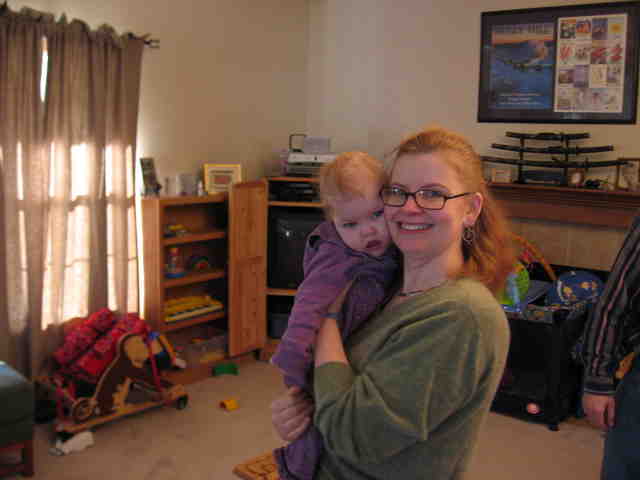
 Allisson and Julia
 Sorry, no room for John...(hey thanks for taking the pic tho')
Saturday was taken up by a long drive from Bloomington to my Dad's outside Philadelphia.
Bloomington is home to the main campus of Indiana University. It's also home to Allisson and John and Belinda and Julia, which was why I went there. Allisson and I have a history that goes back to mutual friends we each met while (separately) at Syracuse University. We've generally only seen each other at weddings and funerals, so I thought a visit was in order, especially after the arrival of Zilla and the Bird aka Belinda and Julia, now about 1.5 years old. Given the nature of small children and their oft-frazzled parents, the visit was predictably low-key.
We had a lovely dinner and beer at Lennie's (thanks Allisson!) on Thursday night. Friday we managed to get out to the Encore Cafe for lunch. These two options showed that the Midwest is not completely devoid of eating possibilities for us vegetarians. (See my previous entry, where I mention the food offerings at Cedar Point's.)
After lunch we had a leisurely stroll around parts of the nearby McCormick's Creek State Park, punctuated by overly-difficult (and eventually abandoned) stream crossings, and an extended visit to the playground.
Fortunately I remembered to take a few pictures before I left.
Belinda liked my phone, so I took her picture with it. Belinda liked the camera too
 Allisson and Julia
 Sorry, no room for John...(hey thanks for taking the pic tho')
Saturday was taken up by a long drive from Bloomington to my Dad's outside Philadelphia.
Tuesday, October 11, 2005
Road Trip, Illinois

I spent a few days visiting with Mom in Wheaton, IL. I've done this before, but have usually flown. On Tuesday we lovely afternoon in Chicago visiting this place:

The Oriental Institute is the University of Chicago's Near East Studies organization. Its museum has been under renovation for a number of years, so I never had chance to see it (also since we would be preoccupied by going to Chicago's other fine museums, like the Art Institute and the Field Museum. In any event, we had a great time there, spending considerably longer than either of us had anticipated. Anyone visiting Chicago should consider a visit there.
After that, we trundled up to the Navy Pier in Chicago, which is mostly a tourist trap and convention center. We went mainly to admire the contents of the Stained Glass Museum, which is essentially a free exhibit, skirting one side of the convention facilities, of a wide variety of stained glass windows.
On Wednesday, we again traveled into Chicago, this time to see the Art Institute's special exhibit on Toulouse-Lautrec, the well-known fin-de-siécle French artist. It was a well-staged exhibit, including many of his best-known works (quite a few of which were advertising posters, and are thus fairly recognizable). It also included vintage movie snippets from the time, as well as a later recreation of the Moulin Rouge scene from this movie.
While there, we met up for lunch with Karen, one the Earthwatch volunteers with whom I was in Spain. Hi Karen!
Tuesday, October 04, 2005
Road Trip, Ohio
I've not spent any substantial time in Ohio since I was in high school. (No offense to Ohioans reading this, but those have just been the turnings of my life.) At that time (1979), I went to Cleveland to check out Case Western Reserve University. It got dropped off my school candidate list at least partly because it was, well, located in Cleveland, which was none too attractive at the time.
For this visit, I drove right through Cleveland. But I do understand that times are better now than then, and this was not intended as a slight on Cleveland. It was mainly due to the fact that I had to drive 700 miles that day, so a sightseeing stop there was not in the cards. I did get a small sampling of radio stations, though. The local NPR affiliate has quite a variety of foreign language programs unlike anything we get in the Boston area. I heard parts of German, Russian (or some other Slavic tongue), and Hungarian programs.
My destination for the night was East Harbor State Park, which is located between Port Clinton and Marblehead, Ohio. This part of Ohio, about midway between Toledo and Cleveland, is fairly rural, and, being on Lake Erie, features a heavily boating- and recreation-oriented atmosphere.
I arrived at about 6:15, and was stopped by a ranger well before the checkin area. It turns out they were having some sort of Halloween celebration this weekend (and next), and I couldn't drive to my campsite until 6:30, due to trick-or-treat-like activities.
Halloween on October 1st? Huh?
Apparently, this part of Ohio celebrates Halloween for the entire month, or something, since Cedar Point was also decked out in orange and black. Whatever happened to celebrating (or recognizing) days like this on just that day?
I eventually got my camp set up, had some dinner (leftovers from the European trip -- thanks Eric), and eventually got to bed (err, sleeping bag) around 9, mostly avoiding the hay ride and haunted house.
On Sunday I was up fairly early (gotta learn how to shut down that sun detector if I'm ever going to sleep really late), and went for a short drive around the Marblehead peninsula. It's got some nice views of Sandusky and Cedar Point, which I didn't photograph since I didn't have the camera along.
I drove into Sandusky itself, which was predictably sleepy at 9:30 on Sunday morning. Things were already getting going at Cedar Point, though. I was through the gates shortly after 10.
I rode a whole bunch of roller coasters. Really! Top Thrill Dragster was closed. My favorites were the Magnum XL-200, Raptor, and Mean Streak, each of which I rode several times. I also rode Millenium Force twice, but it didn't make the cut due to its long(ish) line (about 40 minutes).
I also ate plenty of bad-for-you fair food. Based on the food offerings at Cedar Point, it's no surprise Americans are getting fat. (I don't think there was a single salad on offer in the whole park.) At least I didn't need to make dinner...
On Monday morning I again arose early, and this time prepared myself to take some pictures of the sunrise. These were taken between 6:30 and 8 AM.
 The first view.
 The first view, overexposed. What a difference!


For this visit, I drove right through Cleveland. But I do understand that times are better now than then, and this was not intended as a slight on Cleveland. It was mainly due to the fact that I had to drive 700 miles that day, so a sightseeing stop there was not in the cards. I did get a small sampling of radio stations, though. The local NPR affiliate has quite a variety of foreign language programs unlike anything we get in the Boston area. I heard parts of German, Russian (or some other Slavic tongue), and Hungarian programs.
My destination for the night was East Harbor State Park, which is located between Port Clinton and Marblehead, Ohio. This part of Ohio, about midway between Toledo and Cleveland, is fairly rural, and, being on Lake Erie, features a heavily boating- and recreation-oriented atmosphere.
I arrived at about 6:15, and was stopped by a ranger well before the checkin area. It turns out they were having some sort of Halloween celebration this weekend (and next), and I couldn't drive to my campsite until 6:30, due to trick-or-treat-like activities.
Halloween on October 1st? Huh?
Apparently, this part of Ohio celebrates Halloween for the entire month, or something, since Cedar Point was also decked out in orange and black. Whatever happened to celebrating (or recognizing) days like this on just that day?
I eventually got my camp set up, had some dinner (leftovers from the European trip -- thanks Eric), and eventually got to bed (err, sleeping bag) around 9, mostly avoiding the hay ride and haunted house.
On Sunday I was up fairly early (gotta learn how to shut down that sun detector if I'm ever going to sleep really late), and went for a short drive around the Marblehead peninsula. It's got some nice views of Sandusky and Cedar Point, which I didn't photograph since I didn't have the camera along.
I drove into Sandusky itself, which was predictably sleepy at 9:30 on Sunday morning. Things were already getting going at Cedar Point, though. I was through the gates shortly after 10.
I rode a whole bunch of roller coasters. Really! Top Thrill Dragster was closed. My favorites were the Magnum XL-200, Raptor, and Mean Streak, each of which I rode several times. I also rode Millenium Force twice, but it didn't make the cut due to its long(ish) line (about 40 minutes).
I also ate plenty of bad-for-you fair food. Based on the food offerings at Cedar Point, it's no surprise Americans are getting fat. (I don't think there was a single salad on offer in the whole park.) At least I didn't need to make dinner...
On Monday morning I again arose early, and this time prepared myself to take some pictures of the sunrise. These were taken between 6:30 and 8 AM.
 The first view.
 The first view, overexposed. What a difference!


Friday, September 30, 2005
Road Trip!
OK, so Our President has said to cut back on driving. Since I've never listened much to him before (except to occasionally groan at either what he says or how he says it), why start now? (I will be listening to my wallet groan, courtesy of current gas prices.)
For the next ten days or so I will be traveling, mostly for the purpose of visiting friends and family. My first stop is Sandusky, Ohio, which is home to a large amusement park famous for its rollercoasters.
I'm stopping there because (1) it's between here and Wheaton, Illinois, which is where Mom lives, and (2) Wheaton is about 1000 miles from here, so I need to stop somewhere, and (3) there are rollercoasters nearby.
Stay tuned for trip details. Bear will be coming along (although he is a bit shy of rollercoasters, so he'll be skipping that part).
For the next ten days or so I will be traveling, mostly for the purpose of visiting friends and family. My first stop is Sandusky, Ohio, which is home to a large amusement park famous for its rollercoasters.
I'm stopping there because (1) it's between here and Wheaton, Illinois, which is where Mom lives, and (2) Wheaton is about 1000 miles from here, so I need to stop somewhere, and (3) there are rollercoasters nearby.
Stay tuned for trip details. Bear will be coming along (although he is a bit shy of rollercoasters, so he'll be skipping that part).

Tuesday, September 27, 2005
Volunteering for the government
I mentioned a few posts back that I was looking at a volunteer opportunity at the local National Archives. I was shown around the place last week by the volunteer coordinator there.
For people who think that archives look like scenes at the end of this movie, you'd be wrong, since that's a warehouse where stuff is kept. The Archives is where documents are kept (like the original Declaration of Independence in Washington, say). So if you instead think of scenes from this TV show where the intrepid investigators are poring over documents on shelves in a large high-ceilinged room full of floor-to-ceiling shelving that are filled with (a) boxes (b) more boxes (c) even more boxes (d) some moldy old books ... well, that's a somewhat more realistic picture. (Note to self: try to see if a camera can go in there.)
Volunteers at this site perform two different functions. The first is "front desk" duty, helping out newbies to find things. Did I mention this facility is open to the public? The second is what they call "project" work, which is doing basic preservation of documents.
What kind of documents, I hear you say?
This particular archive contains things like court records, immigration records, shipping and customs records, and so on. There's a large body of materials, much from the 19th century, that needs some basic preservation: documents need to be (sometimes carefully) unfolded, content briefly examined, and refiled into acid-free storage boxes. Extremely fragile (i.e. nearly crumbling) documents are placed in mylar envelopes. They have more complex work too, but figure this is a good speed for a newbie.
I figured this might be a nice way to see if I want to do some sort of conservation work (either art or history), and gives me a window into regional history, while letting me actually handle Old Things.
Since this is the government, I have to fill out paperwork. To wit: I need to permit the FBI to do a background check, and I need to get fingerprinted (a service ably performed by the local police). And I need to provide a resume with two references. And I'm not even getting paid. Humph.
For people who think that archives look like scenes at the end of this movie, you'd be wrong, since that's a warehouse where stuff is kept. The Archives is where documents are kept (like the original Declaration of Independence in Washington, say). So if you instead think of scenes from this TV show where the intrepid investigators are poring over documents on shelves in a large high-ceilinged room full of floor-to-ceiling shelving that are filled with (a) boxes (b) more boxes (c) even more boxes (d) some moldy old books ... well, that's a somewhat more realistic picture. (Note to self: try to see if a camera can go in there.)
Volunteers at this site perform two different functions. The first is "front desk" duty, helping out newbies to find things. Did I mention this facility is open to the public? The second is what they call "project" work, which is doing basic preservation of documents.
What kind of documents, I hear you say?
This particular archive contains things like court records, immigration records, shipping and customs records, and so on. There's a large body of materials, much from the 19th century, that needs some basic preservation: documents need to be (sometimes carefully) unfolded, content briefly examined, and refiled into acid-free storage boxes. Extremely fragile (i.e. nearly crumbling) documents are placed in mylar envelopes. They have more complex work too, but figure this is a good speed for a newbie.
I figured this might be a nice way to see if I want to do some sort of conservation work (either art or history), and gives me a window into regional history, while letting me actually handle Old Things.
Since this is the government, I have to fill out paperwork. To wit: I need to permit the FBI to do a background check, and I need to get fingerprinted (a service ably performed by the local police). And I need to provide a resume with two references. And I'm not even getting paid. Humph.
Sunday, September 25, 2005

Friday, September 23, 2005
Really, I'm not just moving the ladders around

That's about 3 hours work. Keeping fingers crossed for tomorrow to finish this coat.
The glorious whitewasher
The weather cooperated yesterday, so the project now has had primer applied.

Where's Ben Rogers when I need him to do the first finish coat? (Also, where are the weather gods to send away this morning's drizzles?)

Where's Ben Rogers when I need him to do the first finish coat? (Also, where are the weather gods to send away this morning's drizzles?)
Wednesday, September 21, 2005
Garfield (NOT the stupid cartoon cat)
Went for a modest (6 1/2 hour) hike today. (Surrounded by 2 1/2 hours of driving on either side as is fairly usual...) It was cold (40s) and windy on the summit, but I was prepared.
 That's about as nice as the visibility ever gets these days.
 That's Owl's Head behind me. The wall I'm holding up was once part of the foundation to a summit building (fire warden's house or fire tower) here.
Tomorrow, back to work on my Tom Sawyer project. One day of nice weather, hope I can make the most of it.
 That's about as nice as the visibility ever gets these days.
 That's Owl's Head behind me. The wall I'm holding up was once part of the foundation to a summit building (fire warden's house or fire tower) here.
Tomorrow, back to work on my Tom Sawyer project. One day of nice weather, hope I can make the most of it.
Tuesday, September 20, 2005
rain, rain, go away
It rained last Saturday, and it's rained today. This makes continuing this work a bit difficult, since I need to wait at least 36 hours after rain before continuing. At least I've gotten all the sanding done (thanks to the Narf's emergency backup sander, after mine broke down).
I've used the rain intervals to somewhat good effect, and will be visiting the local National Archives on Thursday to see what kind of volunteer projects they have. Stuff to do with cataloging and conserving immigration records, based on what I've read so far. Stay tuned.
On tap for tomorrow: Mount Garfield
I've used the rain intervals to somewhat good effect, and will be visiting the local National Archives on Thursday to see what kind of volunteer projects they have. Stuff to do with cataloging and conserving immigration records, based on what I've read so far. Stay tuned.
On tap for tomorrow: Mount Garfield
Friday, September 16, 2005
Geek stuff
Since rain has descended on the Boston area, I've been unable to make progress on the back of the house, which is currently stuck in the sanding phase of paint-prep. I've instead started focusing on other activities.
First, on the technology front: I've decided to learn PHP. For the non-geeks reading this, it's a language for writing and managing dynamic web pages. There exist a number of blogging software packages that use it, and I'm imagining that this site will eventually be migrated to one of those.
In addition to learning PHP, I also want to familiarize myself with Eclipse, which is an IDE for doing lots of different development tasks.
To these ends, I've been reintroducing myself to the Apache Web Server, and will also be getting to know the MySQL database system.
Soon I may be a dangerous web site backend maintainer, since I will be armed with a small amount of knowledge about these tools and technologies.
Second, I've started investigating volunteer opportunities in the Boston area. My current focus is on ESL tutoring possibilities, since I'm considering getting an ESL teaching certificate at some point in the near future.
First, on the technology front: I've decided to learn PHP. For the non-geeks reading this, it's a language for writing and managing dynamic web pages. There exist a number of blogging software packages that use it, and I'm imagining that this site will eventually be migrated to one of those.
In addition to learning PHP, I also want to familiarize myself with Eclipse, which is an IDE for doing lots of different development tasks.
To these ends, I've been reintroducing myself to the Apache Web Server, and will also be getting to know the MySQL database system.
Soon I may be a dangerous web site backend maintainer, since I will be armed with a small amount of knowledge about these tools and technologies.
Second, I've started investigating volunteer opportunities in the Boston area. My current focus is on ESL tutoring possibilities, since I'm considering getting an ESL teaching certificate at some point in the near future.
Tuesday, September 13, 2005
European Trip Thread
The links in this entry are a chronological listing of the blog entries I made that describe my travels in Europe during July and August 2005.
Finland
- The Big Day
- The Ride Out
- Train Hijinks
- Tampere
- The Finnish Sign Quiz
- Tahkovuori
- Nilsiä and Opera Cava
- Canoeing Preparations
- Canoe Tour Day 1
- Canoe Tour Day 2
- Canoe Tour Day 3
- Canoe Tour Day 4, and Tampere
- Return to Germany
Germany
Paris
Barcelona
Las Alpujarras
The Earthwatch Dig
Spanish Cities
- Sevilla
- Córdoba
- Madrid and Cercedilla
- Zaragoza
- Salamanca
- Ciudad Rodrigo
- Madrid
- Some Hazards of Traveling Alone
- Toledo
Paris Again
Monday, September 12, 2005
Waterfire
So last Saturday, after a very nice afternoon visit from several people, I drove down to Providence, Rhode Island with Herself. The purpose of this drive, besides indulging in a picnic dinner of sandwiches and homemade gazpacho (which was a bit too spicy, but that's another post), was to once again see Waterfire.
Well, see doesn't quite do it justice. Experience is a more apt description of the, well, experience. While your computer probably has sound (the fires are accompanied by a wide variety of music, often on water- or fire-based themes), it does not come with Smell-O-Vision to also pick up the aroma of cedar smoke that accompanies the experience.
Or the street scene, which in a small way is reminiscent of the evening wanderings in Spanish and other Mediterranean cities after dark.
 This the main waterpark before sunset.
 One of the torch ships goes by before lighting begins.


Oh, while we were there we had what Herself claims is a Rhode Island specialty (although Google Image Search turns up lots of places where they're made), the Eccles Cake. Regardless of its origin, they're tasty.

Well, see doesn't quite do it justice. Experience is a more apt description of the, well, experience. While your computer probably has sound (the fires are accompanied by a wide variety of music, often on water- or fire-based themes), it does not come with Smell-O-Vision to also pick up the aroma of cedar smoke that accompanies the experience.
Or the street scene, which in a small way is reminiscent of the evening wanderings in Spanish and other Mediterranean cities after dark.
 This the main waterpark before sunset.
 One of the torch ships goes by before lighting begins.


Oh, while we were there we had what Herself claims is a Rhode Island specialty (although Google Image Search turns up lots of places where they're made), the Eccles Cake. Regardless of its origin, they're tasty.

Subscribe to:
Comments (Atom)


